Porto-North-Portugal.com
The best independent guide to Porto
Porto-North-Portugal.com
The best independent guide to Porto
1 Week in Porto: My itinerary for 2026
Portugal takes its name from Porto, and once you have spent a week here you will understand why the country was built around this city rather than the other way round. The Douro carved the landscape, the port wine cellars built the fortunes, and the granite churches and tiled façades have watched over it all for the better part of a thousand years. Porto wears its history without fuss, and after twenty-five years of coming here with my Portuguese wife and her family, I'm still finding corners I haven't seen.
You could see the headline sights of the city itself in two or three days. The Ribeira's tangle of cobbled lanes, the iron sweep of the Dom Luís I bridge, the gilded interior of São Francisco, the climb up the Clérigos Tower, an afternoon in the port lodges of Vila Nova de Gaia. It's all walkable, and none of it disappoints. But to stop there would be to miss the real reason for staying a full week.
Porto sits at the centre of a region you'll want to explore, and the train and metro will take you to most of it. In under an hour you can be in Guimarães, where the first king of Portugal was born and the medieval centre has barely changed in six hundred years. A little further north is Braga, the country's religious capital, with its monumental Baroque staircase climbing to Bom Jesus do Monte.
East of the city, the Douro Valley unfolds into what I'd argue is the most beautiful wine region in Europe: terraced vineyards falling steeply to a river that has carried the port trade for three hundred years. South lies Aveiro and its canals, and a long stretch of Atlantic coast strung with golden beaches and fishing towns. A week gives you the time to do justice to the city and to choose two or three of these as day trips, without the rushed feeling that a shorter stay tends to leave behind.
My wife is Portuguese and much of her family lives in and around Porto, so the city has been our second home for twenty-five years. Everything in this guide comes from those years of going back, written to help you get the most from your week.
My suggested one-week itinerary for Porto
The itinerary below is the one I would recommend to a friend visiting for the first time. It gives you two full days to settle into Porto itself, then uses the excellent train network to reach the best of the surrounding region without the need for a car.
• Day 1: Historic Porto: Spend your first day in the heart of the city, walking the cobbled lanes of the Ribeira and ticking off the headline sights along the way.
• Day 2: Vila Nova de Gaia: Cross the Dom Luís I bridge for a tour and tasting in the port cellars, then ride the vintage tram out to Foz where the Douro meets the Atlantic.
• Day 3: Guimarães: A direct train takes you to the birthplace of Portugal, with its medieval centre, hilltop castle, and the palace of the first Dukes of Braganza.
• Day 4: Braga: Portugal's religious capital, home to the country's oldest cathedral and the extraordinary Baroque staircase climbing to Bom Jesus do Monte.
• Day 4 alternative: a day at the beach. If the weather is good, swap Braga for the Costa Verde, where a short metro or train ride brings you to long Atlantic beaches and excellent seafood.
• Day 5: The Douro Valley: One of Europe's most beautiful wine regions, with terraced vineyards falling steeply to the river. The slow train from São Bento is the best way to see it.
• Day 6: Aveiro & Costa Nova: A pretty canal town often paired with the striped beach houses of Costa Nova just along the coast.
• Day 7: Lamego: A historic town on the edge of the Douro, famous for its own monumental Baroque staircase climbing to the Nossa Senhora dos Remédios sanctuary.
• Day 7 alternative: Vila do Conde: A working fishing town with a handsome historic centre and a long sweep of golden beach, easily reached on the metro.
To help you picture how the week fits together, the interactive map below plots every stop on the itinerary. Zoom in and out to see how the city sights, day trips, and coastal alternatives sit in relation to one another.
Legend: 1) Ribeira 2) Ponte Luís I 3) Sé do Porto 4) Torre dos Clérigos 5) Vila Nova de Gaia 6) Foz do Douro 7) Guimarães 8) Braga 9) Bom Jesus do Monte 10) Matosinhos 11) Espinho (beach) 12) Miramar (beach) 13) Póvoa de Varzim (beach) 14) Peso da Régua 15) Pinhão 16) Tua 17) Aveiro 18) Costa Nova 19) Lamego 20) Vila do Conde
Day 1: The Historic Heart of Porto
Your first day belongs to the old city, and it is best walked from the top of the hill down to the river. Start at the Clérigos Tower, where the climb up the narrow stone staircase is rewarded with the best rooftop view in Porto, the terracotta tiles of the old town spreading out towards the Douro below.
From there, it is a short walk down to São Bento Station, where you should step inside even if you have no train to catch. The entrance hall is lined with more than 20,000 azulejo tiles depicting scenes from Portuguese history, and it is one of the most beautiful railway stations anywhere in Europe. A few minutes further on stands the Sé Cathedral, a fortress as much as a church, built in the 12th century when Porto's wealth needed defending as well as displaying.
Close by is the Igreja de São Francisco, plain on the outside and almost overwhelming within, its Baroque interior covered in more than 100kg of gold leaf. The contrast between the austere stone façade and the gilded extravagance inside is one of the strangest and most memorable sights in the city.
From the cathedral the streets fall steeply towards the Ribeira, Porto's riverfront quarter and the soul of the old city. The cobbled lanes here are tangled and narrow, opening suddenly onto the wide quayside with the Dom Luís I bridge sweeping across to Gaia. Find a table at one of the cafés along the water, order a glass of something cold, and watch the city work. You have earned it.
Related articles: Sights and attractions of Porto
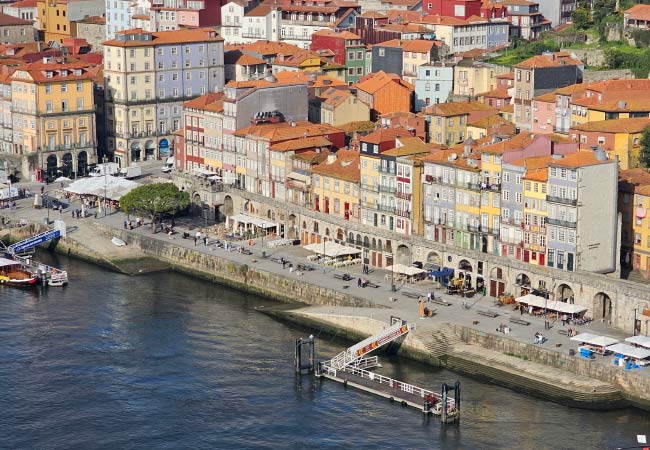
The Ribeira district of Porto
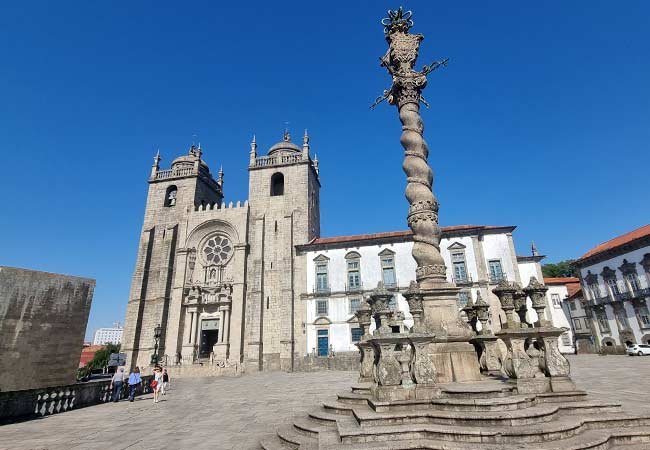
The Sé Cathedral
How about a guided tour?
A guided tour is a hassle-free way to see Porto, and often the easiest way to fit in a day trip to the Douro, Guimarães or Braga without a long day on public transport. I have worked with GetYourGuide for the past eight years, and the highest-rated tours of Porto and the surrounding region include:
Day 2: Vila Nova de Gaia & the Foz District
Day two begins by crossing the Dom Luís I bridge on foot, and I would urge you to take the upper deck for the walk over. The view back towards the Ribeira is the one that ends up on every postcard, and it is even better in the morning light before the crowds arrive.
On the far side lies Vila Nova de Gaia, technically a separate city but in practice the other half of Porto. The riverfront here is given over almost entirely to the port lodges, the long, low cellars where the wine has been aged since the 17th century. Most of the famous names run tours, and they vary more than you might expect. Sandeman is the slickest and busiest, Taylor's the most traditional, and Graham's sits high on the hillside with what I think is the best view of any cellar in Gaia. An hour inside one of them, walking between the giant oak vats and ending with a tasting of tawny and ruby, is the best introduction to port you will ever get.
Before you leave Gaia, take the cable car up to the terrace of the Mosteiro da Serra do Pilar. The panorama from here, with the bridge in the foreground and the Ribeira climbing the far bank, is the finest view of Porto from anywhere in the city.
In the afternoon, head back across the river and pick up the number 1 tram from Infante. The line rattles its way along the riverbank for about half an hour, following the Douro as it widens towards the sea, and drops you in Foz do Douro, where the river finally meets the Atlantic. This is Porto's wealthy seaside quarter, all wide promenades, low rocky beaches, and grand 19th-century houses. Walk out to the Felgueiras lighthouse if the weather holds, then settle in at one of the cafés along the seafront and watch the sun drop into the ocean. After the density of the old city, the sea air is exactly what the day calls for.
Related articles: Port tours - The Foz district
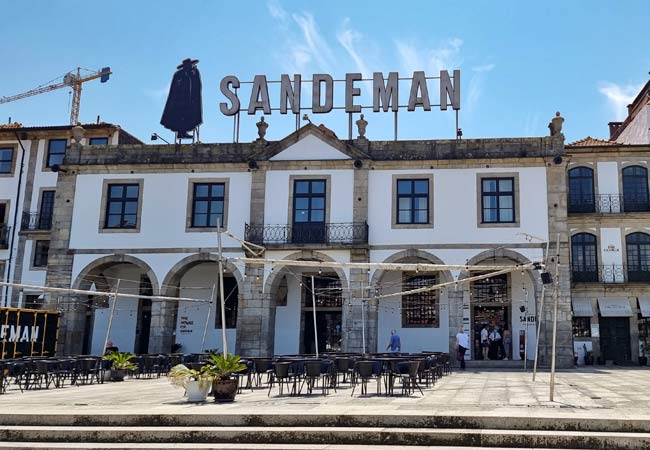
The Sandeman Port cellar in Vila Nova de Gaia
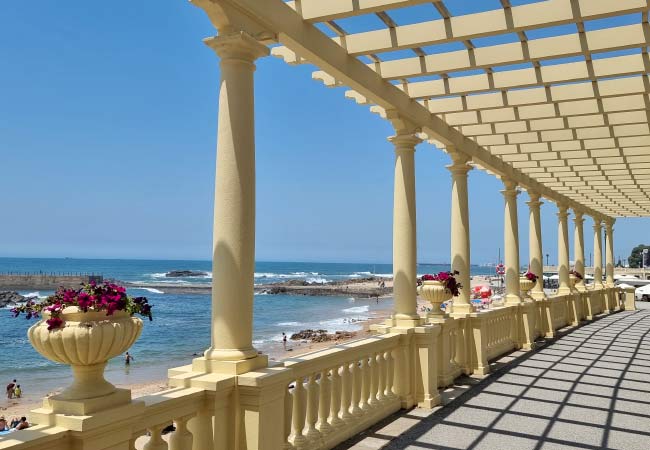
The Pérgola da Foz, overlooking the Praia do Molhe beach
Have you booked your hotel yet?
Demand for accommodation is very high during the peak season, so we advise booking your hotel rooms now before they sell out. To check current prices and availability, enter your holiday dates in the search box below:
Day 3: Day trip to Guimarães
Carved into the wall of Guimarães Castle is a phrase that sets the tone for the whole town: Aqui nasceu Portugal, "Portugal was born here". This is no marketing line. Afonso Henriques, the first king of Portugal, was born in this castle in 1110, and from this hilltop he launched the campaign that would carve a kingdom out of the western edge of Iberia. Nearly nine hundred years later, Guimarães still wears that distinction with quiet pride, and it makes for one of the best day trips you can take from Porto.
The direct train from São Bento takes a little over an hour, and the medieval centre is a ten-minute walk from the station. Start at the top of the hill with the castle itself, a squat granite stronghold of seven towers that has barely changed since the 12th century. Next door stands the Palace of the Dukes of Braganza, built in the 15th century in a Burgundian style that looks oddly out of place in northern Portugal, its forty-odd brick chimneys giving it the silhouette of a French château.
From the castle, the streets fall down through the old town to the Largo da Oliveira, the loveliest square in the city and the place where the locals gather over a coffee or a glass of vinho verde. The buildings around it are an unbroken run of medieval and early Renaissance façades, and a small Gothic monument in the centre commemorates a 14th-century battle won against the Castilians. You could spend a happy hour here doing nothing in particular, which is rather the point.
If you have the legs and the time, finish the day with the cable car up to the Penha sanctuary, set in pine woods on the hill above the town. The ride takes about ten minutes, and the view back across Guimarães and the green Minho countryside is the reward.
Related articles: Guimarães guide
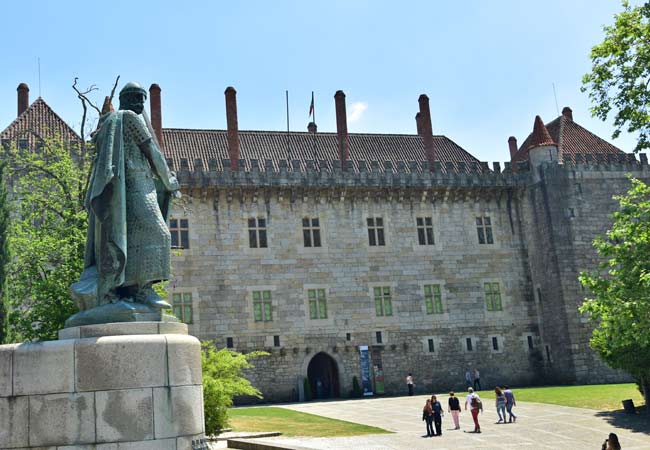
The Gothic Paço dos Duques de Bragança and the statue of Afonso Henriques, the first king of Portugal
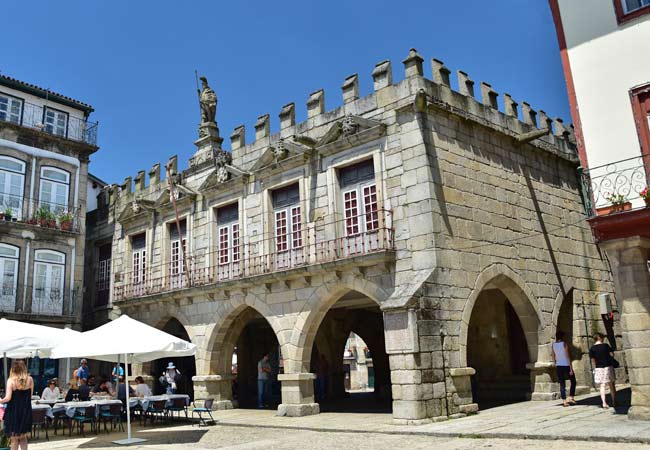
The historic centre of Guimarães and the Old City Hall
Day 4: Day Trip to Braga
This is the religious capital of Portugal, home to the country's oldest cathedral, the seat of an archbishopric that once outranked Lisbon in influence. It is also, somewhat unexpectedly, one of the youngest cities in the country by average age, thanks to its university, and the result is a town that prays hard and goes out late.
The direct train from São Bento takes around an hour. Begin at the Sé de Braga, founded in 1071 and the oldest cathedral in Portugal, predating the country itself by nearly seventy years. The interior is a layered history of every architectural style that has passed through Iberia, from Romanesque arches to Gothic chapels to Baroque organs that are still played at services on Sunday mornings.
From the cathedral the old town opens up, compact and almost entirely pedestrianised. Walk through the Arco da Porta Nova into the Praça da República, where half of Braga seems to gather at the cafés on a sunny afternoon. Close by you will find the Jardim de Santa Bárbara, a small formal garden running alongside the wall of the Archbishop's Palace, and the Raio Palace, an 18th-century townhouse whose entire blue-tiled façade looks like it was iced rather than built. In my mind it is the prettiest building in the city.
The day's main event lies a short bus or Uber ride out of town. Bom Jesus do Monte is the great pilgrimage church of northern Portugal, and the climb up to it is the spectacle. A monumental Baroque staircase zigzags up the wooded hillside in a pattern of white walls and grey granite, punctuated at every landing by chapels, fountains, and allegorical statues. There are 577 steps in all, and the climb is meant to be slow and contemplative, a journey through the senses to the church at the top. If your legs object, the water-powered funicular built in 1882 still runs alongside the staircase and is the oldest of its kind in the world. The view from the terrace at the top, out over Braga and the green Minho beyond, is the right way to end the day.
Related articles: Braga guide
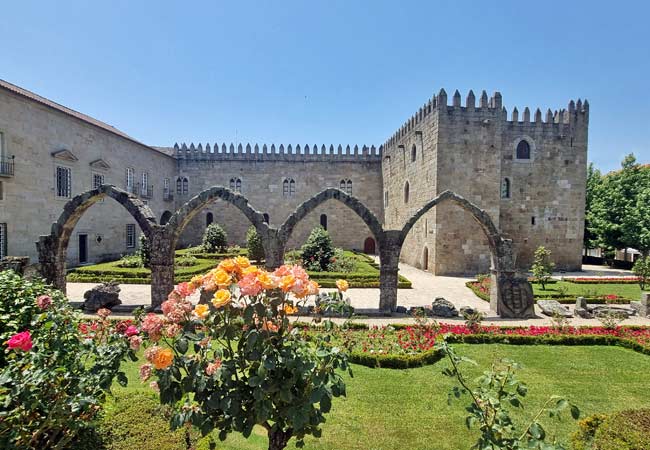
The pretty Jardim de Santa Bárbara at the centre of Braga
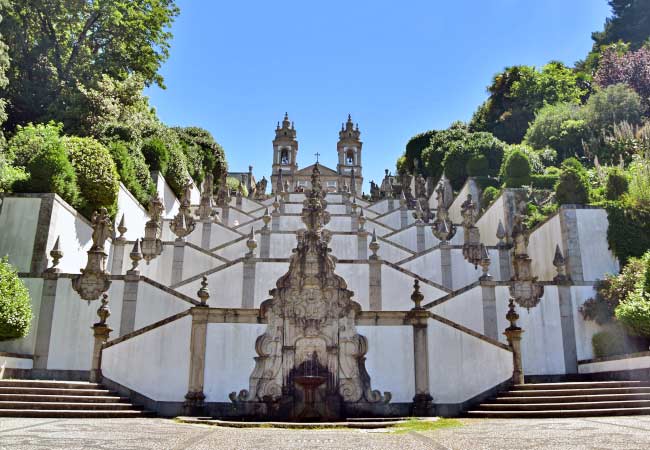
The Bom Jesus do Monte, and the stairway to heaven
Day 4 alternative: A Relaxing Beach Day
If the weather is kind and the thought of another cathedral feels like one too many, swap Braga for the coast. The Costa Verde, the green coast, runs north and south of Porto in a long sweep of pale sand, low dunes, and Atlantic surf, and the metro and suburban trains will get you to most of it within half an hour.
The easiest option is Matosinhos, fifteen minutes from the city centre on the metro blue line. The beach itself is a wide arc of sand backed by a working port, which is not always the prettiest view, but the beach is sandy and the waters are clean.
For something quieter, take the suburban train south to Miramar, about half an hour from São Bento. The beach is a long stretch of sand and rock pools, and standing on a small outcrop in the middle of it is the Capela do Senhor da Pedra, a tiny whitewashed chapel built in the 17th century on what was once a pagan worship site. Further south, Espinho is the lively resort option, with a long promenade, a Friday market, and a casino if the weather turns.
Related articles: Porto beach guide
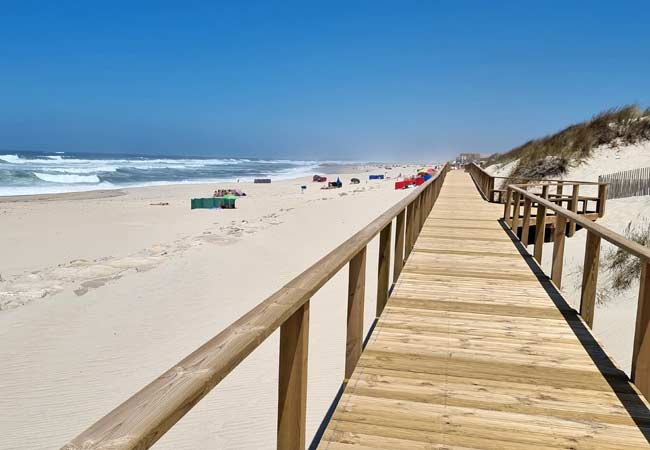
The coastline south of Porto comprises golden sandy beaches and cold Atlantic seawaters; this beach is the Praia de Brito, near Espinho
Day 5: The Douro Valley
The Douro is the oldest demarcated wine region in the world, and for nearly three centuries the steep schist hillsides above the river have been carved into terraces by hand, vine by vine. Photographs do not do it justice. You need to see the scale of it from a train window, or from the water, to understand what generations of work have produced here.
The best way to reach the valley independently is the Linha do Douro, the slow train that runs from São Bento out to Pocinho near the Spanish border. For the first hour the journey is unremarkable, but at Livração the line drops down to the river and from there it follows the Douro all the way upstream. It is one of the great railway journeys of Europe, and I would always take it over driving for the simple reason that you cannot look at the scenery and the road at the same time.
The two stops worth your day are Peso da Régua and Pinhão. Régua is the larger of the two and the historical capital of the port trade, the place where the wine was once loaded onto flat-bottomed rabelo boats for the long journey down to the cellars in Gaia. The Museu do Douro on the riverfront is the best introduction to the region's history if you have an hour to spare.
Pinhão sits 20 minutes further upstream and is, to my mind, the prettier of the two. The town itself is small enough to walk in ten minutes, and the river bends spectacularly here in the heart of the most photographed stretch of the valley.
If you want to be on the water as well as beside it, two-hour river cruises run from both Régua and Pinhão through the afternoon, taking you through the terrace hills. Most of the famous quintas welcome visitors for tours and tastings, and Quinta do Bomfim and Quinta da Roêda are both within walking distance of Pinhão station if you want to combine the train with a tasting.
Related articles: The Douro Valley
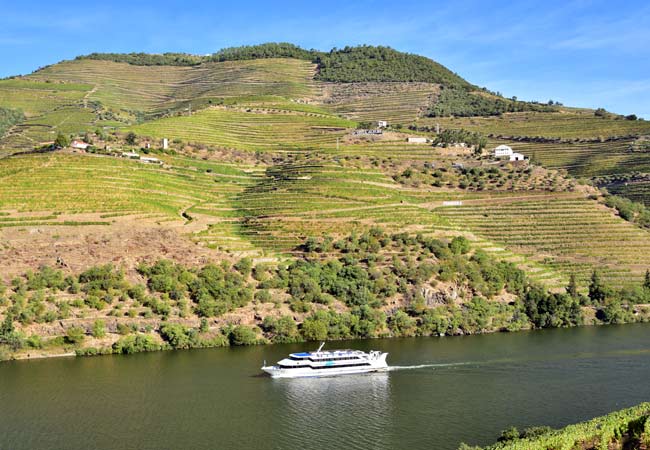
Luxurious cruise ships sail along the Douro
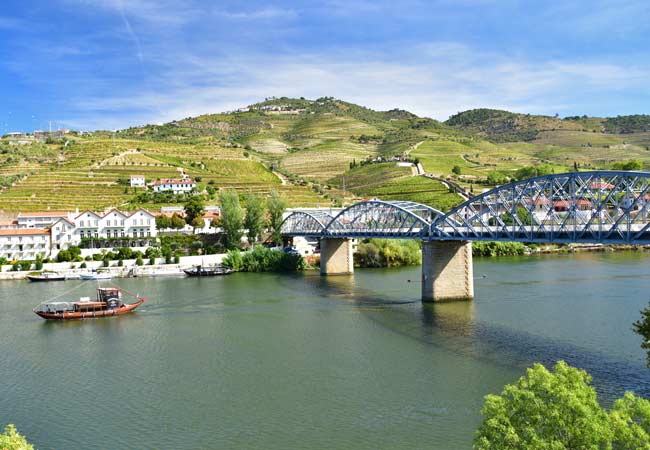
Pinhão is the prettiest town on the Douro River, and is surrounded by hills and terraced vineyards
Day 6: Day Trip to Aveiro & Costa Nova
Aveiro grew up around a vast coastal lagoon, the Ria de Aveiro, where for centuries the locals harvested salt from shallow pans and seaweed for fertiliser using flat-bottomed boats called moliceiros. The salt trade made the town wealthy, and in the early twentieth century that wealth went into a flourish of Art Nouveau townhouses that still line the canals today.
The direct train from Porto's Campanhã station takes about an hour. Start with a ride on one of the moliceiros themselves, now repainted in bright colours and used to ferry visitors along the central canals. The trip takes about forty-five minutes, and the boats are the best way to see the Art Nouveau façades. Afterwards, walk the streets around the Praça do Peixe and the old fish market, where the cafés are good and the ovos moles are everywhere. These are small pastries of egg yolk and sugar wrapped in a thin rice-paper shell, often shaped like fish or shells, and they are the local speciality you cannot leave without trying.
A short bus ride takes you out to Costa Nova, on the narrow strip of land between the lagoon and the Atlantic. The town is famous for its palheiros, the wooden houses painted in vertical stripes of red, blue, yellow, and green. They were originally built as shelters for fishermen and their nets, and the bright colours helped families pick out their own house from a distance in poor weather.
Related articles: Aveiro guide
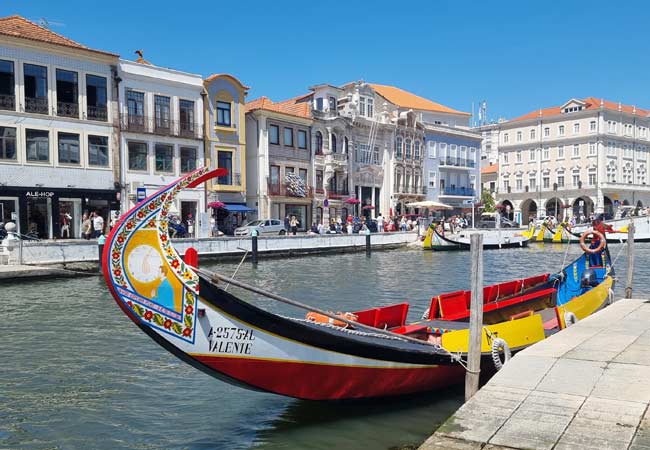
The Moliceiros boats were historically used to harvest seaweed from the lagoon, which was then dried to form an iodine-rich fertiliser
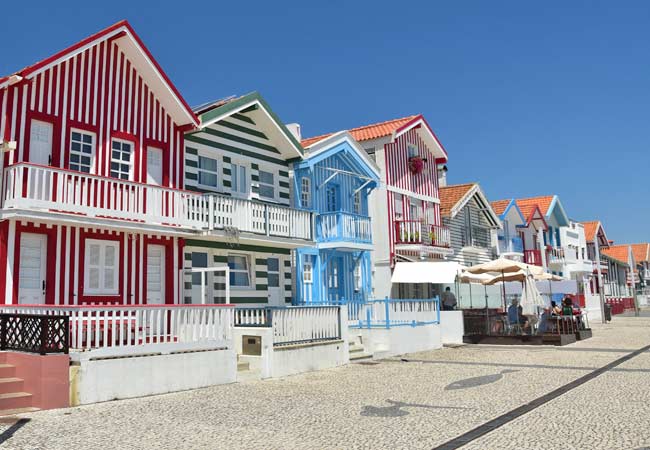
The pretty beach houses of Costa Nova
Day 7: A Choice of History or Coast
For your final day I would offer you a choice rather than a recommendation. If you arrived a wine enthusiast and the Douro on day five only sharpened your appetite, Lamego is the obvious finale. If you have done your share of monuments and the legs are tiring, Vila do Conde and a slow afternoon on the sand will serve you better.
Option 1: Lamego
Lamego sits just south of the Douro and feels like a quieter, slower cousin of the towns along the river. Its defining sight is the Santuário de Nossa Senhora dos Remédios, a twin-towered Baroque church perched on a wooded hill above the town. The church itself is handsome but it is the approach that draws the visitors. A monumental staircase of 686 steps zigzags up the hillside in a series of terraces, each one decorated with fountains, statues of allegorical figures, and panels of blue and white azulejos.
The town below is small and proudly traditional. The 12th-century cathedral has a Romanesque bell tower and a Renaissance interior, and the small castle on the hill above offers a different view back towards the sanctuary. Lamego is also the home of raposeira, Portugal's best-known sparkling wine, and a glass of it with a plate of the local smoked ham makes for the right kind of lunch. The town is reached by bus from Porto via Régua.
Related articles: Lamego guide
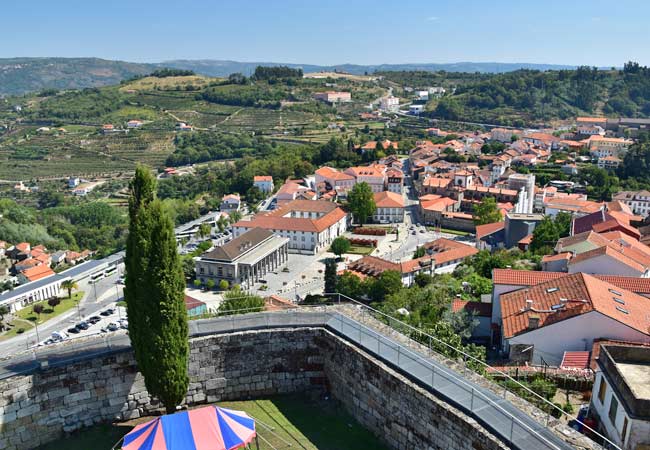
The historic centre of Lamego as seen from the Castelo de Lamego
Option 2: Vila do Conde
If the coast is calling, Vila do Conde is the simpler choice, and it sits at the end of the Porto metro line, around forty minutes from the city centre. The town is a working fishing port that grew up at the mouth of the River Ave, and its character has been shaped by two industries that still define it: the boats and the bobbin lace. The lace is taught at a small school in the centre and the women working at the windows are happy for you to watch.
Above it all looms the Mosteiro de Santa Clara, a 14th-century monastery the size of a small fortress, sitting on a bluff over the river. From the historic centre it is a short walk over the river to the southern beaches, a long sweep of pale sand backed by low dunes and far quieter than Matosinhos. Bring a towel, find a café, and end your week the way most Portuguese holidays end: with sand between your toes and the Atlantic in front of you.
Related articles: Vila do Conde Guide
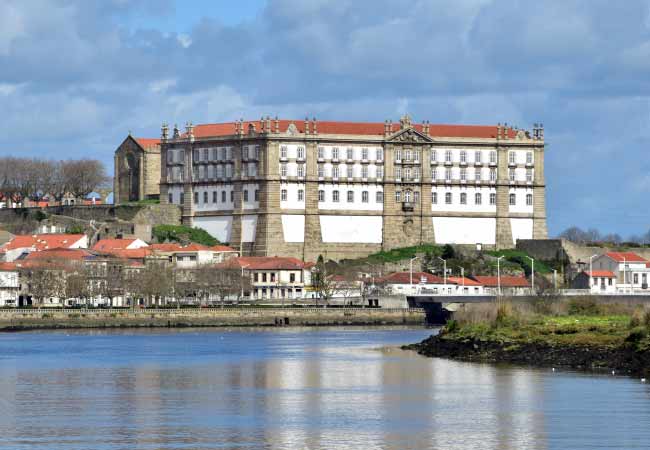
The Mosteiro de Santa Clara dominates the skyline of Vila do Conde.
Our most popular guides to Porto


Expert Insight: I'm Philip Giddings. I've been visiting Portugal since 2001 and now live here, in the Graça district of Lisbon, with my Portuguese wife Carla, whose family go back generations. Carla first brought me to Porto on an early trip, proud to show me her country, and 25 years on we still travel north almost every month to see her aunt and extended family, who live in the city.
I've been writing the independent guides at Porto-North-Portugal.com since 2010, and the site is now my full-time work. Living in Portugal, married into a Portuguese family, and walking Porto every month gives me a first-hand insight that many foreign blog writers simply don't have.
The site now has 174 guides on Porto and northern Portugal. It takes no payment from tourist boards, tour operators, or attractions for inclusion, and is funded by affiliate commissions on tour bookings, which are disclosed on every page that contains them. Every practical detail (ticket prices, opening hours, bus routes, time-slot policies) is checked against official sources and verified in person on the walks I make through the city. Read my full story here.