Porto-North-Portugal.com
The best independent guide to Porto
Porto-North-Portugal.com
The best independent guide to Porto
Porto beaches: a beach guide for 2026
Most visitors come to Porto for the port wine and river tours, and leave without realising they were a short tram ride from one of the finest stretches of coastline in northern Europe. This is their loss. Porto is the gateway to the Costa Verde, a 60km run of golden sand, granite headlands, and Atlantic surf that begins at the mouth of the Douro and stretches in both directions for as long as you care to follow it.
What I love about this coast is its variety. Within the city itself, the small coves of the Foz do Douro sit handsomely beneath an elegant promenade, perfect for a half-day stroll with the sea on one side and grand villas on the other. A short metro ride north brings you to Matosinhos, where a vast golden beach is backed by some of the best seafood restaurants in the country. Travel a little further and the coastline opens up properly: the wild dunes south of the river towards Miramar and Aguda, the historic charm of Vila do Conde, the lively resort town of Póvoa de Varzim, and the long sands of Espinho, where fishermen still pull their boats onto the beach beside the largest casino in the north.
The seawater here is cold, even at the height of summer, and the Atlantic wind has shaped both the coastline and the people who live along it. But on a clear July day, with the sun high and the waves rolling in, you will understand why the Portuguese themselves choose these beaches for their holidays.
I have been exploring Portugal since 2001, and together with my Portuguese wife I have spent more than two decades getting to know this coastline, from sunny afternoons with my nieces at Matosinhos to blustery beach hikes in the depths of winter. This guide shares what we have learned, so you can match the beach to the day you have in mind, whether that is a sheltered cove for the children, a long sandy stretch for a lazy afternoon, or a wild and windswept headland.
My favourite beaches near Porto
Porto's coastline offers something for every kind of beach day, from a quick stroll along the Foz promenade to a full day on the wide sands of the Costa Verde. Below are my favourites, with the easiest way to reach each one.
Praia do Homem do Leme (6km, bus 500)
The best beach within the Porto city limits, a handsome little cove at the northern end of the Foz promenade, framed by the elegant Pérgola da Foz and a string of grand seafront villas. Close enough to feel part of the city, and easy to fold into a morning of sightseeing.
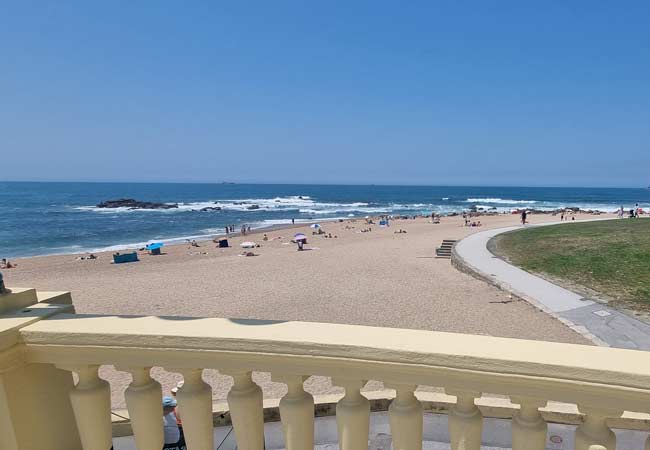
Praia de Matosinhos (8km, metro line A)
The largest and most popular beach near Porto, a vast sweep of golden sand backed by a wide promenade and the best seafood restaurants in the region. The fishing harbour, docks and cruise port at the southern end are not the prettiest backdrop, but the water is clean and the sand soft and golden. The locals clearly agree: the moment the sun comes out, half the city descends here.
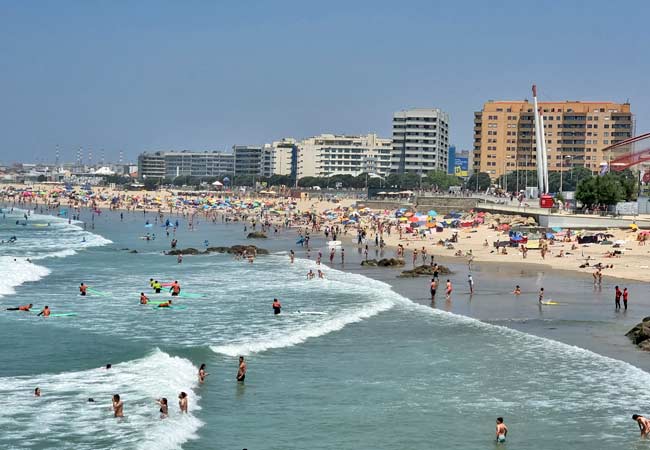
Praia do Senhor da Pedra (14km, urban train)
The most scenic beach south of Porto, a wide stretch of pale sand with a tiny 17th-century chapel perched on a rocky outcrop in the surf. The setting is wilder than anything closer to the city, and the urban train from São Bento drops you ten minutes' walk from the sand.
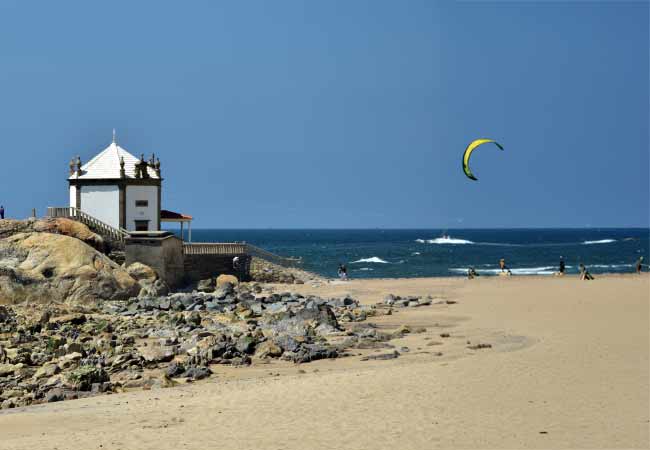
Praia da Aguda (20km, urban train)
The best family beach in the region, a sheltered bay where the waves are gentler than the rest of this coast and a working fishing community still pulls boats up onto the sand each morning. This is the beach I take my nieces to.
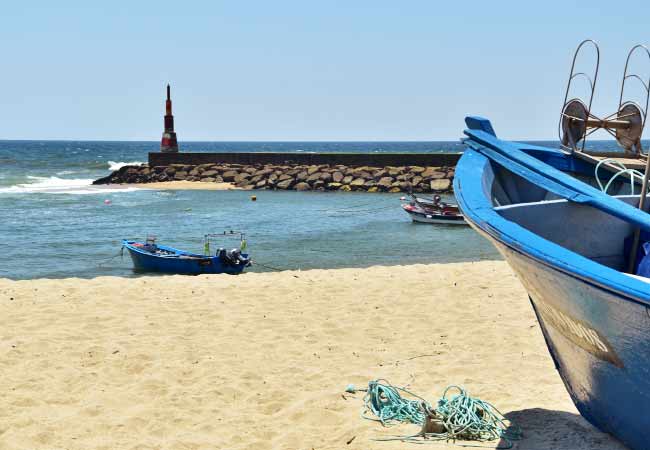
Praia da Azurara, Vila do Conde (27km, metro line B)
A 6km arc of pale sand backed by dunes and little else. It extends south from the mouth of the River Ave and stays remarkably empty, even in summer. A good choice if you want space and quiet in high summer, and one of my favourite spots to surf out of season.
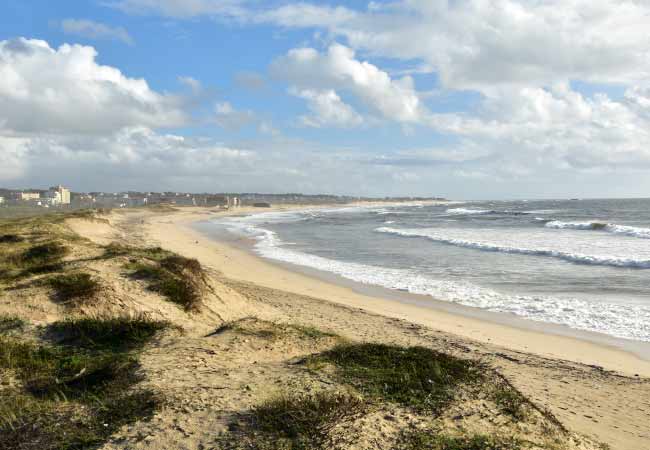
Praia de Espinho (18km, urban train)
The liveliest resort beach south of Porto, 8km of golden sand fronting a town hugely popular with the Portuguese themselves. Colourful fishing boats still pull up beside the largest casino in the north, and the surf is good enough to host international championships.
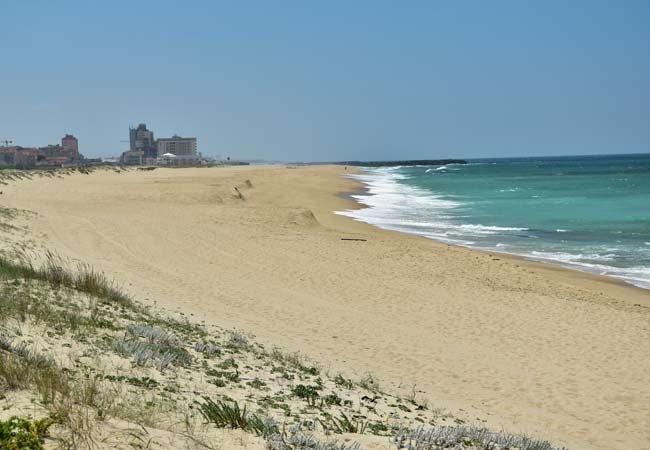
Praia de Costa Nova (75km, train to Aveiro then bus)
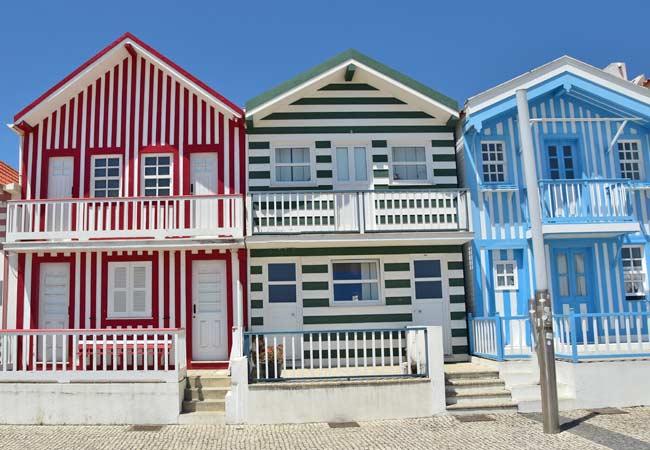
The most distinctive beach within reach of Porto, fronted by the famous candy-striped beach houses, painted so fishermen could spot them through the Atlantic fog. The sands themselves stretch for miles behind protective dunes.
The map below shows the location of my favourite beaches (yellow markers) and my favourite resort towns (green markers), so you can plan around where you are staying.
The top 10 beaches: 1) Praia do Senhor da Pedra (Miramar) 2) Praia Redonda (Póvoa de Varzim) 3) Praia da Azurara (Vila do Conde) 4) Praia das Sereias (Espinho) 5) Praia da Ladeira Norte (Vila do Conde) 6) Praia das Pedras do Corgo (Lavra) 7) Praia da Aguda (Aguda) 8) Praia de Matosinhos 9) Praia do Homem do Leme (Porto) 10) Praia do Carneiro (Porto)
The top 5 resort towns: 1) Vila do Conde 2) Costa Nova 3) Póvoa de Varzim 4) Espinho 5) Miramar
Where we go for a beach trip
After more than two decades of beach days along this coast, I have settled on a handful of choices that I return to again and again, depending on the kind of day I have in mind.
For a simple day on the beach using public transport, I would head south to Praia do Senhor da Pedra or Praia da Aguda. These two beaches sit next to each other on the same stretch of pale sand, and between them they have everything I want from a Portuguese beach day: clean Atlantic water, an unhurried local feel, and a café at the back of the sand for a long lunch. The urban train from São Bento drops you at Miramar or Aguda within forty minutes, and the two beaches are an easy walk.
For a longer day that combines a beach with a town worth exploring, I head north to Vila do Conde and Praia da Azurara. This is the trip I take visiting friends and family on, so they can see the region properly. The metro from Porto takes you straight there, and a long, dune-backed beach inside a nature reserve paired with a charming historic centre and its 16th-century convent is hard to better in a single day.
When I have only half a day to spare and I want to stay close to the city, I head for Praia do Homem do Leme at the northern end of the Foz promenade, or sometimes one of the smaller coves further south along the same stretch. The bus 500 from Praça da Liberdade gets you there in twenty minutes, and the walk back along the seafront is half the pleasure.
If I want a livelier afternoon close to the city, I take the metro (or Uber) to Praia de Matosinhos. The fishing docks and cruise terminal at one end mean it is far from the prettiest setting on this coast, but the sand is wide, the waves are reliable, and the seafood restaurants on Rua Heróis de França are among the best in the country for lunch or dinner.
When I am with friends who have young children, I take them a little further up the coast to Praia de Leça da Palmeira, just beyond the Matosinhos docks. It is home to the Piscinas de Marés, Álvaro Siza's celebrated seawater pools cut into the rocks, which offer the safest swimming on the whole Porto coast. The combination keeps everyone happy, particularly on the windier summer days when the open Atlantic is too rough for smaller swimmers.
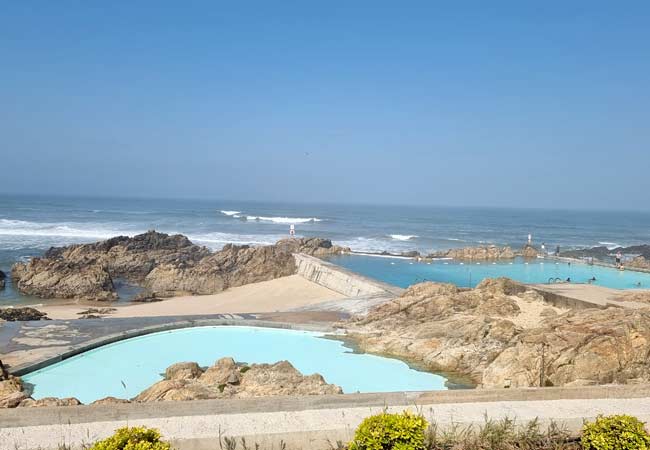
The Piscinas de Marés at Leça da Palmeira, ideal for families with young children
The Foz do Douro: Porto's city beaches
Where the Douro finally meets the Atlantic, the city changes character. The granite buildings and tiled façades of the centre give way to wide skies, salt air, and a string of small sandy coves broken by dark outcrops of rock. This is the Foz do Douro coastline, a 3km stretch of beaches lining the city's most affluent district, and the easiest place to find sand and sea without leaving Porto.
Let me be honest: these are not the finest beaches on this coast. The sand is coarser, the coves are smaller, and the Atlantic wind has nowhere to hide. If you have the time to travel further north or south, you will find better. What the Foz beaches offer instead is convenience and atmosphere. A regular bus from Praça da Liberdade puts you on the sand within twenty minutes, the promenade behind makes a fine walk on a summer's day, and the Avenida do Brasil that runs along the back of the beaches is lined with some of the city's most stylish bars and restaurants. For a half-day on the sand, a coastal walk with the Atlantic at your shoulder, or a sunset drink with a view, the Foz coastline is hard to better.
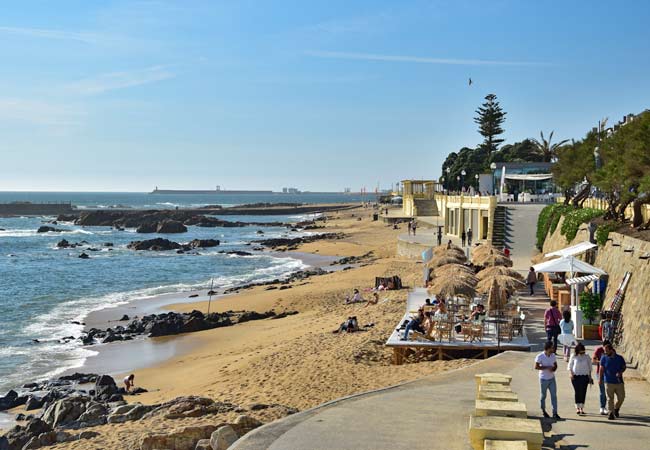
The Foz do Douro coastline
The beaches themselves run from south to north in a single sequence, each one tucked between rocky headlands.
Praia do Carneiro is the most southerly, sitting almost at the mouth of the Douro itself. The 17th-century Fortaleza de São João da Foz stands above it, and a long granite breakwater extends out into the estuary, sheltering one end of the sand.
North of Carneiro come Praia do Ourigo, Praia dos Ingleses, and Praia da Luz, three small coves that run almost into one another. Praia dos Ingleses, the Beach of the English, takes its name from the British community drawn to Porto by the port wine trade, who in the 19th century made a habit of taking the sea air here. All three have a similar character, with golden sand, granite outcrops at either end, and a handful of bars and restaurants on the road behind.
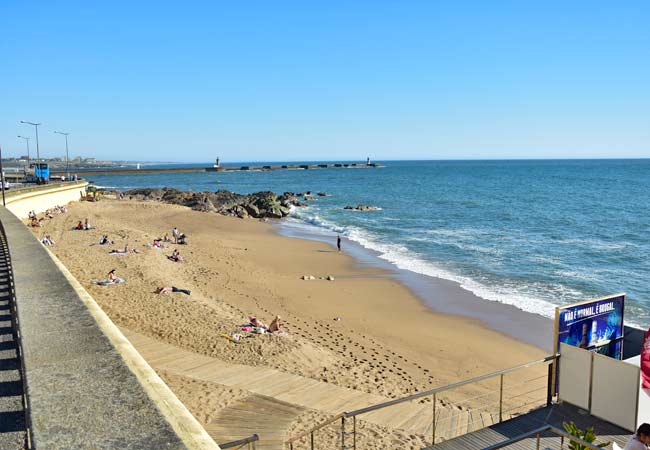
Praia do Ourigo
Beyond these come the broader sands of Praia de Gondarém and Praia do Molhe, the most popular stretch of the Foz coastline. Behind the beach stands the Pérgola da Foz, a long curving 1930s Neoclassical pergola modelled on the Promenade des Anglais in Nice and built at the request of the mayor's wife, who had fallen for the original on a trip to the French Riviera. It is the most romantic spot in Porto for a sunset, and on a clear summer evening the railings fill with couples watching the sun drop into the Atlantic.
The northern end of the Foz coastline finishes at Praia do Homem do Leme, the largest of the city beaches, sitting just before the coast turns towards Matosinhos. A wide arc of sand backed by a small green park and a children's playground, this is the Foz beach I would choose for a proper afternoon on the sand with children in the group.
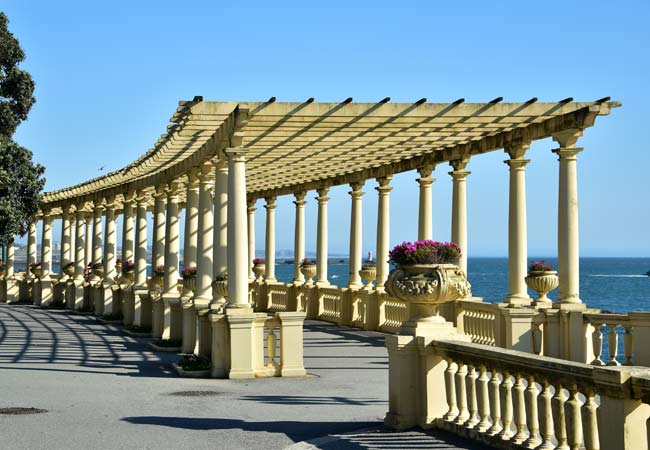
Pérgola da Foz
Travel to the Foz beaches
The 500 bus is the only sensible way to reach this coastline by public transport. It departs every fifteen minutes or so from Praça da Liberdade in central Porto, follows the Douro to its mouth, and then runs the full length of the seafront before continuing on to Matosinhos. The journey takes around twenty-five minutes and stops within a short walk of every beach along the way.
A Z2 ticket on the Andante card costs €1.40, or €2.50 if you pay the driver on board. Honestly, I often just call an Uber for convenience: the fare is typically €5 to €6, and it saves the wait.
Matosinhos: the city's beach
If the Foz beaches are about convenience, Matosinhos is about scale: a long arc of pale sand stretching over a kilometre and a half from the Leixões breakwater in the north to the Castelo do Queijo at the southern end. This is the largest beach within easy reach of Porto, and the one that fills up the moment the summer sun arrives.
I will not pretend this is an idyllic setting. The Port of Leixões sits immediately north of the beach, and the cruise terminal looms over the harbour wall. On a grey day, the industrial backdrop is hard to ignore. But the same massive seawalls that protect the port also shelter the northern end of the beach from the prevailing winds and tame the strong Atlantic currents, and the sands themselves have been steadily replenished by the port authority over the decades. On a hot summer's day, with the wide sands packed with families and surf schools out beyond the breakers, Matosinhos has an energy that no other beach in the region can match.
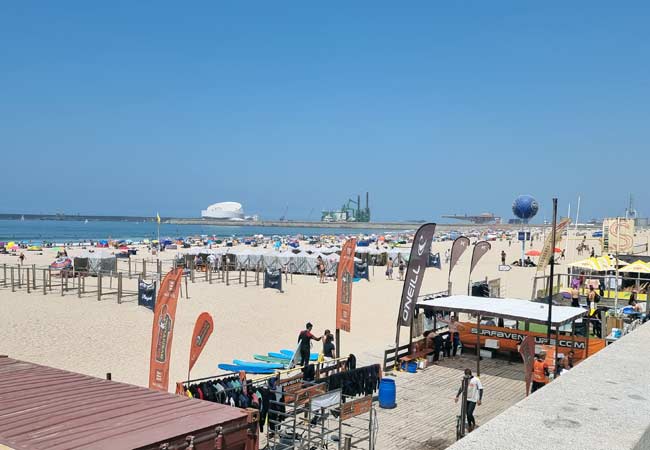
Clear waters and golden sands, there’s a reason Matosinhos is popular
Surfing at Matosinhos
Matosinhos is where most of Porto learns to surf, and after twenty-five years of watching the lessons line up along the sand on Saturday mornings, I can tell you why. The northern end of the beach, sheltered by the Leixões harbour wall, produces the gentle, predictable whitewash that beginners need, while the longer beach breaks further south suit those who already know what they are doing. More than twenty surf schools operate from this beach, and a board and wetsuit can usually be hired for around €15 for a couple of hours. The autumn and spring months bring the cleanest waves, and if you have never surfed before, this is one of the easiest places in Europe to start.
The fish restaurants
The reason most people in Porto go to Matosinhos is to eat. Rua Heróis de França, one street back from the seafront, is lined with more than forty seafood restaurants, most of them grilling whole fish on charcoal burners on the pavement outside.
My two regular choices are O Gaveto and Lage Senhor do Padrão. O Gaveto, at the top end of Rua Roberto Ivens, is the formal pick of Porto's wine trade, and the place I take family for a special meal. Lage Senhor do Padrão is an honest, fairly priced lunch of grilled fish in a granite-walled dining room a short walk from the beach.
Travel to Matosinhos
The metro is the simplest way to get there. Line A (the blue line) runs from Trindade in central Porto to Matosinhos Sul, the closest stop to the beach, in around twenty-five minutes. A Z3 single on the Andante card costs €1.80, and the beach is a five-minute walk from the station.
Porto’s Beaches for children and families
Many of Porto’s beaches are suitable for children and families. They are generally of a high standard (well maintained and clean waters) and are popular with Portuguese families. During the summer season lifeguards supervise the most popular beaches.
Care must be taken when swimming as there can be powerful waves, hidden rocks or strong currents; only swim where it is shown to be safe. Safe waters include the Piscina das Marés pools at the Praia de Leça da Palmeira, the sheltered bay at the Praia da Aguda and the northern side of the Praia de Matosinhos. As indicated in the previous section, the sea temperature is always chilly.
For a family beach holiday within the Costa Verde we would recommend Costa Nova (near Aveiro) or Póvoa de Varzim.
Holiday tip: Sun creams are very expensive in Portugal; bring them from your home country.
Espinho beach is one of the region's largest, with a beach that extends for 17km
Our most popular guides to Porto


Expert Insight: I'm Philip Giddings. I've been visiting Portugal since 2001 and now live here, in the Graça district of Lisbon, with my Portuguese wife Carla, whose family go back generations. Carla first brought me to Porto on an early trip, proud to show me her country, and 25 years on we still travel north almost every month to see her aunt and extended family, who live in the city.
I've been writing the independent guides at Porto-North-Portugal.com since 2010, and the site is now my full-time work. Living in Portugal, married into a Portuguese family, and walking Porto every month gives me a first-hand insight that many foreign blog writers simply don't have.
The site now has 174 guides on Porto and northern Portugal. It takes no payment from tourist boards, tour operators, or attractions for inclusion, and is funded by affiliate commissions on tour bookings, which are disclosed on every page that contains them. Every practical detail (ticket prices, opening hours, bus routes, time-slot policies) is checked against official sources and verified in person on the walks I make through the city. Read my full story here.