Porto-North-Portugal.com
The best independent guide to Porto
Porto-North-Portugal.com
The best independent guide to Porto
Where to Stay in Porto: The Best Areas for Your Holiday in 2026
Choose the wrong neighbourhood in Porto and you will spend half your holiday climbing hills you did not plan for. Choose the right one, and the city opens up at your feet.
Porto looks bigger than it is. The city sprawls for miles in every direction, but the historic centre, where you will almost certainly want to be based, is small enough to cross on foot in twenty minutes. What it lacks in width it makes up for in height. Porto is built across two steep granite slopes that drop down to the Douro, and the difference between a hotel at the top and one at the bottom is not measured in metres. It is measured in calf muscles.
Every neighbourhood in Porto comes with a trade-off. The Ribeira looks irresistible from across the river. It looks less irresistible at midnight, when your hotel is a twenty-minute climb back up the hill. Gaia gives you the postcard view, at the cost of crossing the bridge twice a day. Boavista has the smartest business hotels and the easiest parking, but you will be on the metro into the centre most evenings. None of this is a problem once you know it. All of it is a problem if you do not.
Where to stay in Porto: an overview
Porto sits on the northern bank of the Douro, running west towards the Atlantic. The city of Vila Nova de Gaia sits on the southern bank, technically a separate municipality, but for a visitor it is part of Porto and treated as such throughout this guide.
For a first visit, the neighbourhoods to consider are:
1) Ribeira 2) Vitória 3) Vila Nova de Gaia riverfront 4) Sé 5) Baixa 6) Bolhão and Ildefonso. For a business trip, Avenida da Boavista is the obvious choice.
This map shows the central area of Porto and highlights the popular tourist districts of the city.
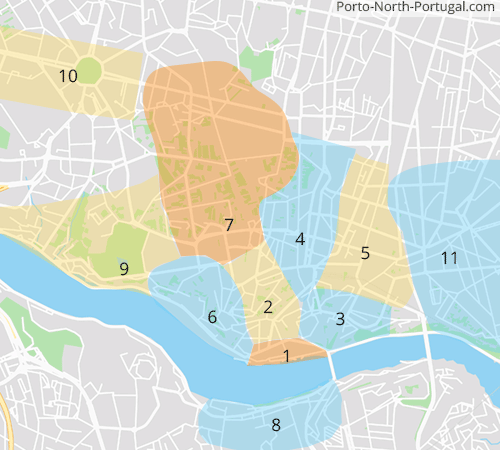
Key: 1) Ribeira 2) Vitória 3) Sé 4) Baixa 5) Bolhão and Ildefonso 6) Miragaia 7) Cedofeita 8) Vila Nova de Gaia riverfront 9) South Massarelos 10) Avenida da Boavista 11) Bonfim
Porto is a year-round city break destination, and the best central rooms go fast at weekends. Leave it to the last minute and you will be looking at hotels well outside the historic centre, or paying considerably more for what is left. Book early and you will have your pick of both.
The map below plots hotels and rental rooms across central Porto. I use it myself when planning trips for friends and family, mostly because the prices match what you'll find direct. Drop in your dates and it will pull through current prices and availability, so you can compare what is open in each neighbourhood before reading on.
A few areas outside the historic centre are also worth a look. Foz, the old fishing district where the Douro meets the Atlantic, is the smartest residential part of the city. Avenida da Boavista, further inland, is where most of the high-end business hotels sit. Matosinhos, the beach suburb to the north, is worth considering if a stretch of Atlantic sand matters more to you than being in the centre. The dotted square on the map below marks the area covered by the first map.
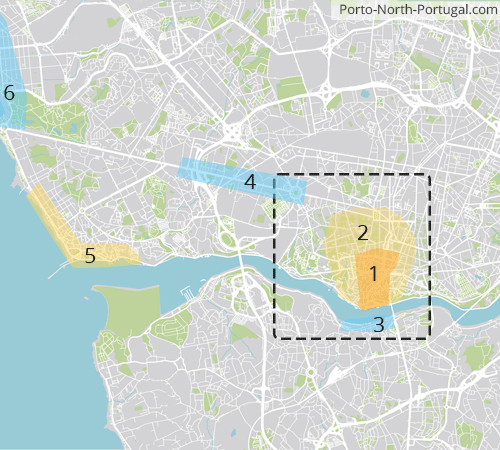
Key: 1) The historic centre 2) The main tourism area 3) Vila Nova de Gaia riverfront 4) Avenida da Boavista 5) Foz district 6) Matosinhos
The best districts and neighbourhoods in Porto
Ribeira
Ribeira is the picture you have already seen of Porto. Tall pastel houses stacked on top of each other, washing strung between them, sloping down to the Douro under the iron arch of the Dom Luís I bridge. UNESCO made it a World Heritage Site in 1996, but the streets have been lived in continuously since the merchant city grew up here in the Middle Ages. The warehouses on the riverfront are now restaurants and hotels. The buskers, the tourist crowds, the clink of Port glasses in the late afternoon, the lit-up lodges on the Gaia bank at night. All part of the deal. So is the noise, well past midnight in summer.
Ribeira is small. Almost everything happens within a hundred metres of the riverfront, so the room you book matters more than the hotel. River-facing rooms come with a view, a premium, and a serious dose of street noise. Rooms one street back are quieter and considerably cheaper, and you are still thirty seconds from the Douro. The riverfront itself is flat. The rest of the historic centre rises steeply up the hill behind it, and any walk back from a late dinner in Baixa or Sé will involve a climb. The Elevador da Ribeira lift, tucked behind the riverfront, takes you halfway up at no charge if you know it is there.
Sé
Sé is the oldest part of Porto. The medieval city that grew up around the cathedral on the highest point of the old town. Twelfth-century alleys, staircases instead of streets, and buildings packed so tightly together that some have no daylight on the lower floors. Walk a single block and you can pass from a beautifully restored townhouse to one held up largely by hope and scaffolding. The cathedral terrace is one of the best free views in the city.
The choice here is character against comfort. Hotels are smaller and fewer than in the neighbouring districts. Lifts are rare, rooms are often quirky, and almost every walk back to your hotel involves stairs. None of that is for everyone, but it is the closest you can get to sleeping inside the medieval city.
Baixa
Baixa is the grand, bustling centre of Porto, built around Avenida dos Aliados and rebuilt at the start of the 20th century. The Beaux-Arts style owes more to Paris than Lisbon. Most of Porto's classic hotels are here, with São Bento station at the southern edge and almost everything a first-time visitor will want to see within a short walk. The southern half of the district, sloping down towards the river along Rua das Flores, is the most walkable and the easiest to recommend.
The cluster of bars on Galerias de Paris and Rua do Almada, on the western edge of Baixa, runs loud on Thursday, Friday and Saturday nights. Pick a street away from those, and Baixa is the most practical base in the city. Pick the wrong one and you will not sleep.
Bolhão and Ildefonso
Bolhão and Ildefonso is the part of Porto where people actually live and shop. The neighbourhood sits between Aliados and the long pedestrian shopping street of Rua de Santa Catarina. At its centre is the Mercado do Bolhão, the city's main covered market since 1914. The streets around it carry a mix of fishmongers, traditional bakeries, and designer boutiques, with the Belle Époque Café Majestic still serving coffee on Santa Catarina much as it did in 1921.
It also has the best metro connections of any of the central neighbourhoods. Bolhão station puts you one stop from São Bento and two from the airport line at Trindade. The catch is that you are a ten-minute walk uphill from the riverfront, which matters at the end of an evening. Worth it for the shopping, the market, and a more local feel than the tourist heart further down the hill.
***Vila Nova de Gaia riverfront
Vila Nova de Gaia is technically a separate city across the river. For the visitor, only one part of it matters: the riverfront, known locally as the Cais de Gaia. This is the strip where the famous Port lodges line up. Sandeman, Taylor's, Graham's, Cálem, all within a few minutes' walk. It is also the only neighbourhood where you wake up looking at Porto itself, the historic centre laid out across the water like a model. The view back towards Ribeira at sunset, with the Dom Luís I bridge silhouetted against the sky, is the picture most people are buying when they book a Gaia hotel.
Two things to know before you book. The first is that the riverfront is flat and walkable, but every other part of Gaia involves a climb. That includes the upper level of the bridge, which connects to the Jardim do Morro metro station. Hotels signposted as "Gaia" can be either at river level or up on the hillside, and the difference matters. The second is that Gaia empties out at night. The day-trippers cross back to Porto for dinner, and the riverfront becomes noticeably quieter after dark. Some people find this the best version of Porto. Others miss the buzz of the Ribeira side.
Cedofeita
Cedofeita is the creative quarter of Porto, an area of independent galleries, concept stores, and the kind of brunch spots that draw a queue on a Sunday morning. The heart of it is not Rua de Cedofeita itself, which has lost a third of its shops since the pandemic, but the parallel Rua de Miguel Bombarda one block over. Twenty contemporary art galleries on a single 650-metre stretch, alongside ceramics shops, vintage stores, and more cafés than any one visitor can reasonably get through. Six times a year, all the galleries premiere new exhibitions on the same Saturday afternoon, and the whole street turns into a slow-moving party.
The catch is that you are a fifteen-minute walk from the riverfront, and a fair distance from most of the classic Porto sights. If you want a base where the morning starts with a flat white and an art gallery, this is the right neighbourhood. If you want to step out of your hotel and be on the riverfront, it is not.
Boavista and the Avenida da Boavista
Boavista is Porto's modern face, a wide tree-lined boulevard running west from the centre towards the Atlantic. The Avenida da Boavista is where the international hotel brands cluster. Sheraton, Crowne Plaza, Holiday Inn Express, the Porto Palácio. The architectural set piece is Rem Koolhaas's Casa da Música, a startling angular concrete block dropped onto a square at the eastern end of the avenue. Its own metro station sits immediately below. The neighbourhood feels closer to a normal European business district than the rest of Porto, which is either the appeal or the problem depending on what you are after.
The case for Boavista is practical. Hotels here have parking, which is the rarest amenity in central Porto. They tend to be larger, quieter, and better equipped than the converted historic buildings closer to the river. The metro runs every few minutes from Casa da Música to São Bento, a ten-minute ride. The case against is that you will be doing that journey twice a day, and you will not be wandering home from dinner along the Douro. For a business trip, a stopover, or a visit where comfort and a parking space matter more than atmosphere, Boavista is the smart choice. For a first holiday in Porto, look at the central neighbourhoods first.
***Miragaia
Miragaia is what Ribeira looks like with most of the tourists removed. It sits just downstream along the river. A medieval neighbourhood that grew up outside the old city walls, it was once the Jewish and Armenian quarter of Porto. Some of its houses are built below river level, on what used to be a shipyard during the Age of Discoveries. A section of the original 14th-century city walls is still visible at the upper edge of the neighbourhood. The colourful shuttered houses and the washing strung between them are the same as Ribeira's. The crowds are not.
Miragaia gives you a quieter version of the riverside, with the same view of Gaia across the water and a short walk to the main Ribeira restaurants when you want them. The catch is the geography. The streets are some of the steepest in central Porto, with several proper staircases instead of pavements, and the area has fewer hotels than apartment rentals. If you are travelling with luggage, plan the last leg carefully.
South Massarelos
South Massarelos is centred on the Palácio de Cristal. A 19th-century landscaped garden with peacocks, panoramic Douro views, and the closest thing Porto has to a park you can spend a whole afternoon in. The neighbourhood itself is quiet and residential. Tiled façades, walled gardens, and a slower rhythm than anywhere closer to the river. It has the Museu Romântico, the Tram Museum, and Antiqvvm, one of Porto's two Michelin-starred restaurants. The riverside tram, the slow scenic line that follows the Douro out to Foz, runs through the bottom edge of the neighbourhood.
A useful base if the more central districts are sold out, or if you have been to Porto before and want a quieter version of the city. Ribeira is fifteen minutes downhill on foot. The same fifteen minutes back up at the end of the evening. One specific warning: do not book any further west than the Arrábida bridge. Past that point, the neighbourhood shades into Bairro do Aleixo, once one of the most deprived parts of the city, and it is not where you want your suitcase ending up.
Bonfim
Bonfim is the part of Porto you read about in the magazine pieces. Time Out named it one of the forty coolest neighbourhoods in the world in 2023, and the Guardian put it on its European list a year earlier. Both were right. Bonfim was an old industrial area that fell quiet in the late 20th century, leaving a stock of warehouses, factories, and tall residential buildings. Over the past decade, those buildings have steadily filled up. Art galleries, record bars, vintage furniture shops, speciality coffee roasters, and a Belas Artes fine arts faculty whose students seed most of the rest. The Fontaínhas viewpoint at the southern edge of the neighbourhood is one of the best places in the city to watch the sun go down over the Douro. It does not appear in many guidebooks.
Bonfim is also unusually flat for central Porto, which makes a noticeable difference at the end of a day on your feet, and it sits immediately east of Bolhão within walking distance of everything. There is a metro station at the centre and the main Campanhã rail station on its eastern edge. The trade-off is that you are further from the riverfront tourist circuit, and accommodation is mostly apartment rentals rather than hotels. For a first visit to Porto, this is the wrong neighbourhood. For a second or third visit, it is the most interesting choice in the city.
Choose your location before looking for accommodation!
Always choose the area of Porto you’d like to be based in before looking for accommodation. This may sound obvious, but it is all too easy to be sucked in by an amazing discount or outstanding reviews, without really considering the area of the city you will be staying in.
Where to stay in Porto? A bit further out
Foz do Douro is a calm and pleasant district at the mouth of the Douro River. The district has a distinctly Portuguese atmosphere, with traditional houses, many excellent restaurants, and scenic walks along the river or seafront. Foz is an ideal location if you’d prefer a more relaxed trip to Porto.
Insight: There is a regular bus service (route 500) that connects Foz to central Porto, with this scenic route following the Douro River.
Matosinhos is a busy fishing town that has the best sandy beach close to Porto. The town is famed for its seafood restaurants and is extremely popular in the summer as the whole of Porto heads to the beach. The 500 bus route connects Matosinhos to central Porto, so it is very easy to travel into the city centre.
Vila Nova de Gaia is the twin city of Porto, lying on the southern side of the Douro River. This city offers much better value accommodation, but the compromise will be the endless walking into central Porto. There is surprisingly poor public transport from Vila Nova de Gaia to Porto, with only four metro stations and a handful of bus services.
Our most popular guides to Porto


Expert Insight: I'm Philip Giddings. I've been visiting Portugal since 2001 and now live here, in the Graça district of Lisbon, with my Portuguese wife Carla, whose family go back generations. Carla first brought me to Porto on an early trip, proud to show me her country, and 25 years on we still travel north almost every month to see her aunt and extended family, who live in the city.
I've been writing the independent guides at Porto-North-Portugal.com since 2010, and the site is now my full-time work. Living in Portugal, married into a Portuguese family, and walking Porto every month gives me a first-hand insight that many foreign blog writers simply don't have.
The site now has 174 guides on Porto and northern Portugal. It takes no payment from tourist boards, tour operators, or attractions for inclusion, and is funded by affiliate commissions on tour bookings, which are disclosed on every page that contains them. Every practical detail (ticket prices, opening hours, bus routes, time-slot policies) is checked against official sources and verified in person on the walks I make through the city. Read my full story here.