Porto-North-Portugal.com
The best independent guide to Porto
Porto-North-Portugal.com
The best independent guide to Porto
The language spoken in Porto
The official language of Porto is Portuguese. However, for visitors travelling to the city and the surrounding region, English is so widely spoken within the tourism industry that there is effectively no language barrier.
Communication in English is standard in hotels, restaurants, and with tour operators, ensuring a smooth and easy visit. Visitors will find that signs in the airport and major train stations are bilingual, transport ticket machines have English language options, and restaurants in popular areas almost always provide an English menu. This high level of English proficiency is partly due to Portugal's education system and the common practice of showing English-language films and television with Portuguese subtitles.
While it is not necessary to learn Portuguese for a short trip, making the effort to learn a few basic words and phrases (such as 'bom dia' for 'good day' and 'obrigado' for 'thank you') is always appreciated by residents and seen as a polite gesture. Ultimately, any perceived language barrier should not be a concern when planning a trip to Porto.
Related articles: Introduction to Porto - Top 10 Porto - Porto Day trips
English in Daily Situations
Language will not be a difficulty when using public transport, as most signs have an English translation. The airport is fully bilingual and very easy to navigate. The only potential difficulty may be with some older taxi drivers, but this can be resolved by having the address of your hotel clearly written down or on a business card. Eating out is also straightforward, as restaurants and cafes in tourist areas commonly have an English menu, and most waiting staff can speak English fluently.
The Portuguese have a surprisingly good understanding of English in part due to their schooling and their exposure to English via music and movies. The Portuguese are exposed to English via their TV as many programmes contain the original English audio with Portuguese subtitles.
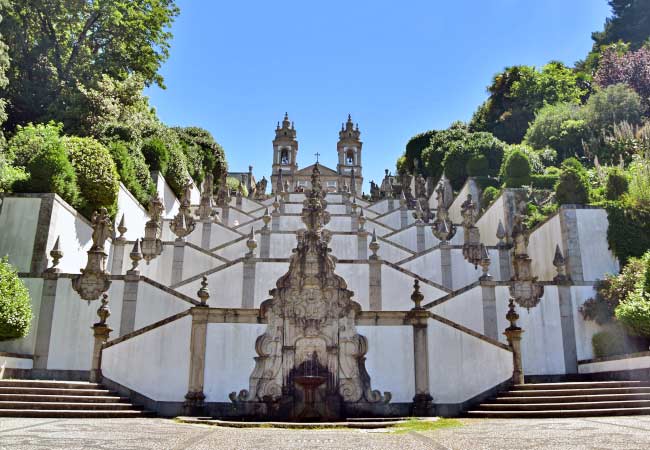
The Bom Jesus church in Braga
The Portuguese Language and its Influences
Written Portuguese and Brazilian Portuguese are very similar, comparable to the differences between UK and US English. The spoken languages, however, have very different pronunciations and accents. Due to migration and the high volume of Brazilian television series shown in Portugal, the Brazilian dialect is slowly influencing the language spoken in Porto.
As a nation, Portugal is protective of its language from the influence of both Spanish and Brazilian Portuguese. Although the written forms of Portuguese and Spanish can appear similar, their spoken forms are very different, with Portuguese having a more nasal, Slavic-sounding quality to many ears.
An interesting local law, designed to protect Portuguese naming traditions, requires children born in Portugal to Portuguese parents to be given a name from a government-approved list. This is one reason why many Portuguese people share common first names.
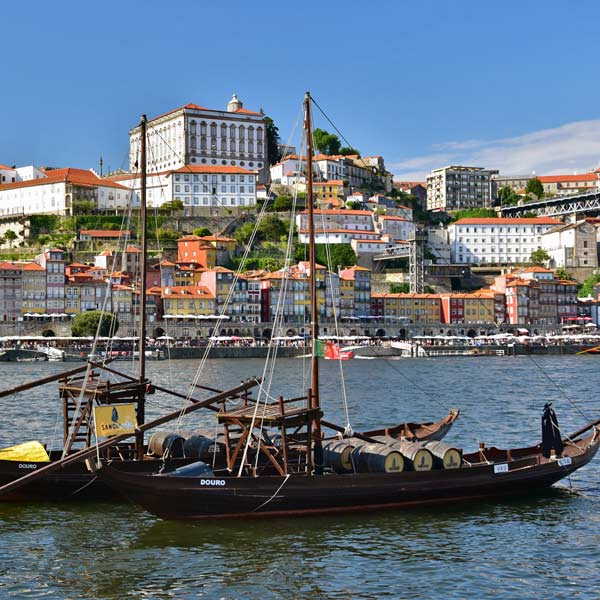
The riverfront of Porto
Is it worth having Portuguese lessons before going to Porto?
For tourists who are learning the language, the Portuguese spoken in daily life can sound very different from the structured methods taught in language programmes.
Spoken Portuguese is often very fast, and it is common for people to talk over each other in lively conversation. Initially, this can make it difficult to follow, but thankfully the number of commonly used words is relatively small, and the general meaning of a conversation can often be understood from just a few key phrases.
Our most popular guides to Porto


Expert Insight: I'm Philip Giddings. I've been visiting Portugal since 2001 and now live here, in the Graça district of Lisbon, with my Portuguese wife Carla, whose family go back generations. Carla first brought me to Porto on an early trip, proud to show me her country, and 25 years on we still travel north almost every month to see her aunt and extended family, who live in the city.
I've been writing the independent guides at Porto-North-Portugal.com since 2010, and the site is now my full-time work. Living in Portugal, married into a Portuguese family, and walking Porto every month gives me a first-hand insight that many foreign blog writers simply don't have.
The site now has 174 guides on Porto and northern Portugal. It takes no payment from tourist boards, tour operators, or attractions for inclusion, and is funded by affiliate commissions on tour bookings, which are disclosed on every page that contains them. Every practical detail (ticket prices, opening hours, bus routes, time-slot policies) is checked against official sources and verified in person on the walks I make through the city. Read my full story here.