Porto-North-Portugal.com
The best independent guide to north Portugal
Porto-North-Portugal.com
The best independent guide to north Portugal
A day trip to Braga from Porto: suggested tour for 2026
Braga is one of the best day trips from Porto, and my favourite town in Northern Portugal. This is Portugal's oldest city, founded by the Romans over two thousand years ago, and for centuries it served as the religious capital of the country.
This varied history has left Braga with an extraordinary concentration of churches, palaces, and monuments packed into a compact and walkable historic centre. But what I find most enjoyable about Braga is its genuine Portuguese atmosphere. This is a vibrant and bustling city with ancient churches lined along pedestrianised shopping streets, and plazas filled with cafes and locals socialising over a coffee and pastry.
Then there's Bom Jesus do Monte, the monumental Baroque stairway and hilltop church that sits just outside the city. For many visitors this ends up being the highlight of the entire trip, and it's worth the journey to Braga in its own right.
The logistics for a day trip are straightforward, with regular trains connecting Porto to Braga throughout the day, and the journey taking a little over an hour. Because Braga isn't a tourist-focused city, it is refreshingly inexpensive, and the whole day can be done comfortably for under €30 including transport, entrance fees, and lunch.
I have been visiting Braga since 2001, and this guide covers everything you need for the perfect day trip.
Highlights for a Day Trip to Braga
Bom Jesus do Monte
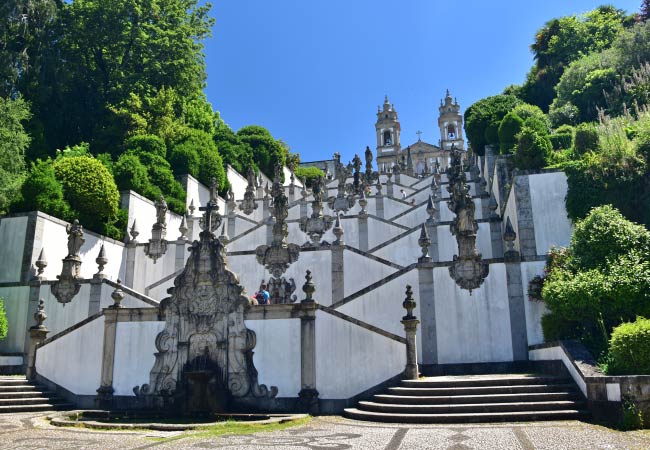
A monumental Baroque stairway that zigzags 116 metres up a wooded hillside through fountains, chapels, and religious sculptures. The climb is split into three sections, each with its own symbolic meaning, and the views from the summit stretch across the Minho valley. If the 577 steps don't appeal, the world's oldest water-powered funicular has been carrying visitors to the top since 1882 (full guide here).
Sé de Braga (Cathedral)
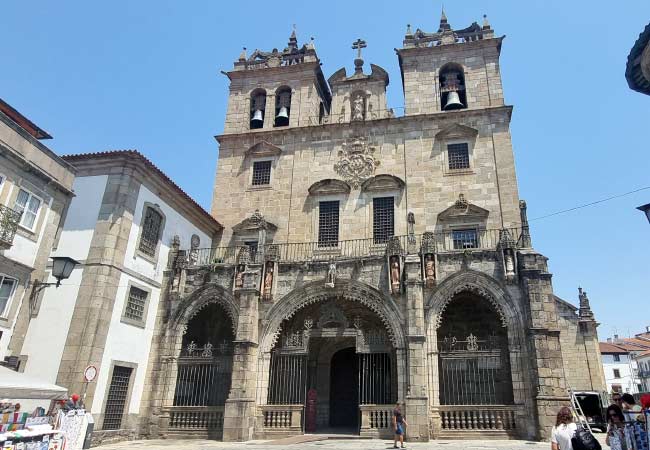
Older than Portugal itself, Braga's cathedral dates to 1089 and has been in continuous use for over 900 years. Inside, heavy Romanesque pillars give way to Gothic columns and Baroque gilding, while a pair of enormous gilded organs with unusual horizontal trumpets face each other across the nave.
Praça da República
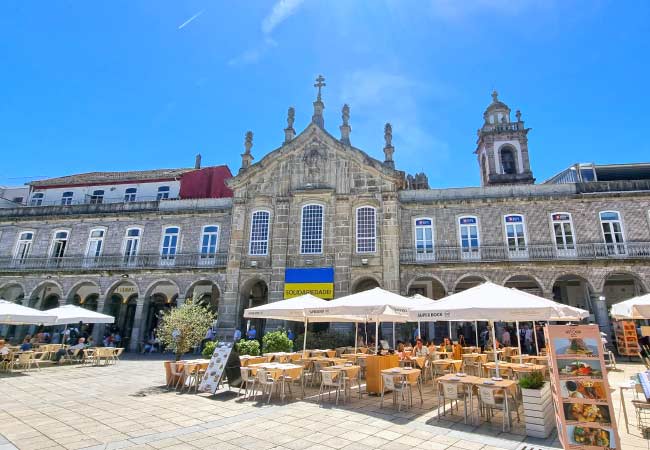
Braga's main square and social hub since the 14th century. Café Vianna has been serving coffee beneath the arches of the Arcada building since 1871, the Torre de Menagem is the last remnant of the medieval castle, and a Baroque fountain from 1723 sits at the centre of it all.
Palácio dos Biscainhos
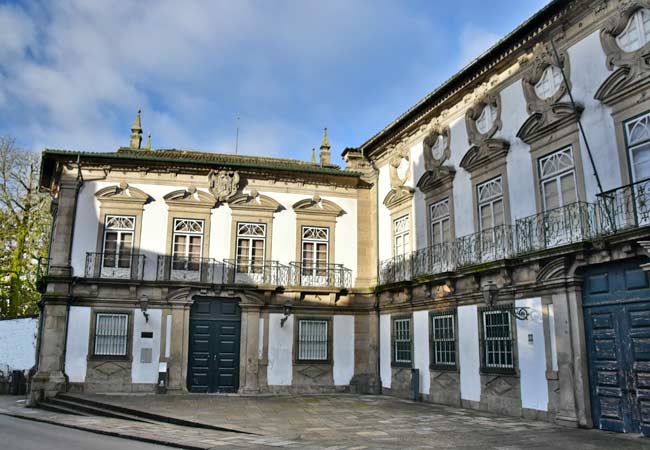
A 17th-century Baroque palace where carriages once drove directly inside to keep guests dry. Now a museum of noble Portuguese life, with painted ceilings, a room dedicated to the ritual of drinking hot chocolate, and gardens hiding concealed fountains designed to spray unsuspecting visitors.
Palácio do Raio
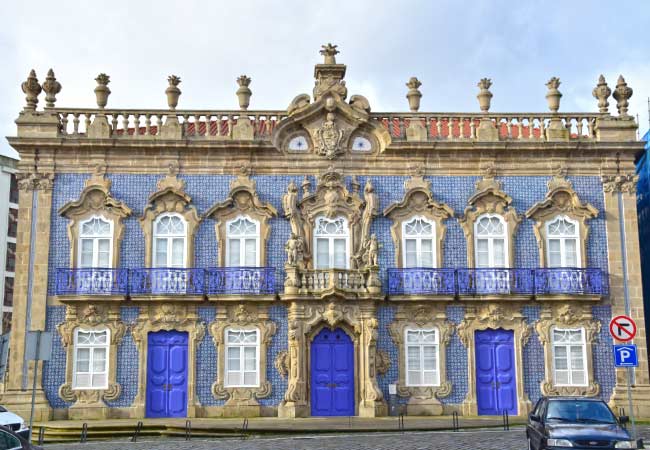
Impossible to miss thanks to the vivid blue azulejo tiles covering its façade, though these were actually a 19th-century addition. The real story is the granite work underneath, designed by André Soares in 1752 with no two window pediments exactly alike.
Prices and Entrance Fees
One of the nice things about a day trip to Braga is how little it costs. Most of the sights have modest entrance fees, the train from Porto is inexpensive, and lunch in the old town won't set you back much either. Here's a rough breakdown of what to budget for:
Porto to Braga train - €7.20 (adult return)
Sé Cathedral (cathedral only) - €2.00
Sé Cathedral (cathedral and museum) - €5.00
Palácio dos Biscainhos - €5.00
Bus to Bom Jesus - €1.55 (single)
Uber or Bolt to Bom Jesus - approximately €5 (one way)
Funicular at Bom Jesus - €2.50 single / €4.00 return
Day Tour Map and Practical Details
Below is an interactive map of the suggested day trip route, the same one I use to show the city to friends and family.
The route through Braga's historic centre covers around 6 kilometres in total, including the walk to and from the train station. Allow roughly three hours at a comfortable pace, though longer if you decide to go inside the Palácio dos Biscainhos (which can always be saved for the end of the day if energy is running low).
The train station sits close to the edge of the historic centre, so you're into the old town within minutes of arriving. One of the things that makes Braga such a pleasant city to walk around is that the centre is almost entirely flat, a welcome contrast to Porto's relentless hills. The historic centre is largely pedestrianised with wide, open streets rather than the cramped pavements and passing traffic you find in cities like Porto or Lisbon. Even on busy days there's a relaxed, unhurried feel to walking around. My parents, who don't particularly enjoy hectic cities, enjoyed Braga so much that they asked to come back and spend longer the second time.
For getting out to Bom Jesus, buses run regularly from Avenida da Liberdade and the journey takes about twenty minutes. Uber and Bolt both operate reliably in Braga and are often the easier option, particularly if there are a few of you splitting the fare. Drivers can drop you at either the base or the summit, depending on whether you want to climb or descend the stairway.
Green markers show the main sights in the historic centre, yellow markers cover the key spots at Bom Jesus do Monte.
Legend: 1) Arco da Porta Nova 2) Sé de Braga 3) Jardim da Praça do Município
4) Convento do Pópulo 5) Palácio dos Biscainhos 6) Jardim de Santa Bárbara 7) Largo São João do Souto 8) Largo do Paço 9) Arcada 10) Convento dos Congregados 11) Theatro Circo 12) Palácio do Raio 13) Igreja de São Marcos 14) Igreja de Santa Cruz 15) Capela de São Bentinho 16) Capela da Nossa Senhora da Torre
Bom Jesus do Monte: 1) Elevador Bom Jesus do Monte 2) Santuário do Bom Jesus 3) Via Crucis 4) Miradouro do Santuário do Bom Jesus
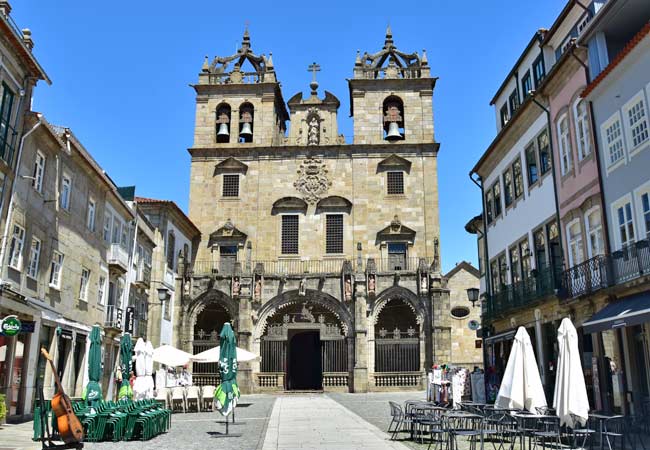
The Gothic Sé Cathedral
Braga, Guimarães or Both?
The question I'm asked most often is "which is better, Braga or Guimarães?" It's a difficult one because they are both excellent in very different ways, and I personally love both of them.
Guimarães has the edge when it comes to pure charm. It was Portugal's first capital, and its medieval centre of narrow cobblestone streets, a hilltop castle, and beautifully preserved palaces is one of the prettiest in the country. Most first-time visitors to Portugal will fall for it immediately.
Braga offers more to actually see and do. The historic centre has a wider variety of sights, from its ancient cathedral to Baroque palaces and hidden chapels, and then there's Bom Jesus do Monte, which has no equivalent in Guimarães. Braga also feels more like a real, working Portuguese city rather than a place that exists primarily for visitors.
If I had to recommend just one for someone new to Portugal, I'd say Guimarães. But if your schedule allows two separate days, visit both. They complement each other well and rushing them together in a single day means you'll barely scratch the surface of either.
Both cities are easy day trips from Porto, and alongside the Douro Valley (Peso da Régua and Pinhão) and Aveiro, they form the essential stops on any northern Portugal itinerary.
Related articles: Porto day trips
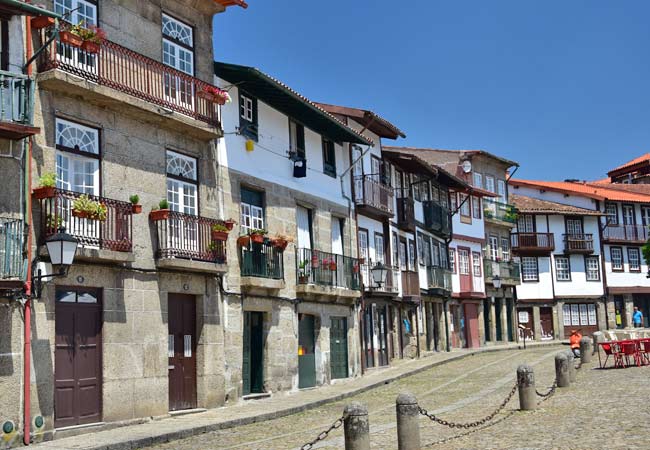
Guimarães is more traditional and characterful
Is a Guided Tour of Braga Worth It?
This is a fair question, and the honest answer depends on how you like to travel.
If you're comfortable navigating public transport and prefer to set your own pace, Braga is a straightforward city to explore independently. The train from Porto is simple, the historic centre is compact, and this guide covers the route in detail.
Where a group tour earns its value is in three areas. First, a good local guide will give you context and stories that you simply won't get from a written guide or a plaque on a wall. Second, the logistics are taken care of (transport, entrance tickets, the bus out to Bom Jesus), so there's nothing to organise on the day. And third, if you're travelling solo, a small group tour is one of the easier ways to meet people and share the experience with someone other than your phone.
The quality of tours in northern Portugal has improved considerably in recent years, and the best ones are led by knowledgeable local guides who genuinely know and care about the region. I've worked with GetYourGuide for seven years, and some of their most popular Braga tours include:
• Braga and Guimarães full-day tour with lunch
• Guimarães and Braga tour with tickets and lunch
Travel from Porto to Braga
Regular direct trains connect Porto to Braga from São Bento station, and this is how I travel to the city for every trip. The train is an urban service with many stops, and the journey takes between 54 and 71 minutes depending on the service.
Trains run at least hourly in both directions, with extra services on weekdays. You'll find the latest timetable on the Comboios de Portugal (CP) website:
www.cp.pt/
(Note: This link downloads as a PDF on mobile devices)
A return fare costs €7.20 for adults and €3.60 for children, loaded onto a reusable Siga smart card (€0.50, worth keeping if you're planning other day trips). Tickets are available from the station or can be purchased from the Comboios de Portugal website. Seat reservations are not possible, but there are always plenty of seats available. Once you arrive, Braga station is just a 300-metre walk to the Arco da Porta Nova, which marks the edge of the historic centre.
While express trains also run to Braga, I recommend sticking with the urban service. The express trains require a connection at Campanhã station, cost twice as much, and surprisingly don't save any time on the journey.
They're especially useful for groups or families, and the real bonus comes at the end of the day, as you can be collected directly from Bom Jesus do Monte instead of heading back into town for the train. I found this invaluable on my last trip with my young nephews, as we could all head straight back to Porto without tiredness or tears on the train.
Related articles: Porto to Braga by train
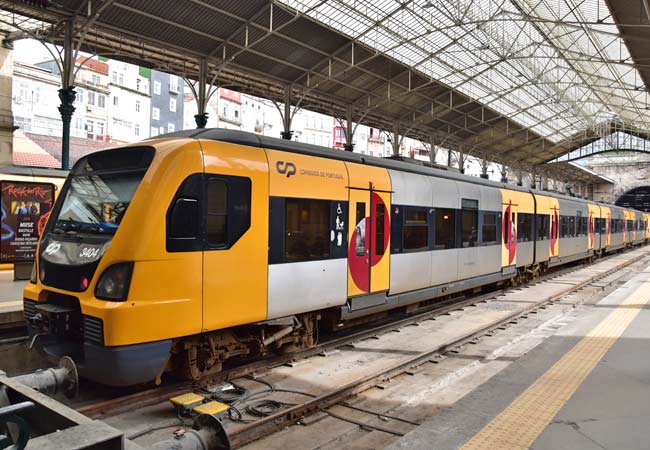
The train to Braga waiting in São Bento station
Travel to Bom Jesus do Monte
Bom Jesus do Monte is located 6km east of Braga, and there are two practical ways to get there.
The most economical option is the Linha 2 bus operated by TUB (Transportes Urbanos de Braga). Buses depart from both Avenida da Liberdade and the train station, with the journey taking around 30 minutes and dropping you at the base of the monumental staircase. A single ticket costs €1.55, payable in cash or by contactless card directly on the bus. You can check the route and current timetable on the TUB website: tub.pt/percurso/2/
Be aware that the bus frequency drops significantly on Sundays and public holidays, sometimes running only once per hour.
For more flexibility, Uber and Bolt both offer direct rides from the centre to Bom Jesus for around €5 to €6. If you'd prefer to skip the stairs entirely, perhaps due to mobility concerns or the heat, make sure to set your destination as the Santuário do Bom Jesus do Monte rather than just "Bom Jesus", which will usually default to the base.
I always catch an Uber for this journey. Sightseeing time and energy are limited on a day trip, and I'd rather spend both on the stairway itself than waiting 20 minutes for a slower bus.
From Base to Summit
The number 2 bus terminates at the base of Bom Jesus hill, where you have two options for reaching the summit.
The first is the historic funicular, the world's oldest water-powered counterbalancing system. Each carriage sits above a 5,850-litre water tank that acts as a counterweight, and it has been carrying visitors up the hill since 1882. A single ticket costs €2.50, or €4.00 return.
The alternative is to walk, though this is a surprisingly long and steep climb. Most of the ascent follows shaded forest paths, with the famous Baroque stairway concentrated in the upper section. I will only do this walk in spring or autumn, as the summer heat makes it too draining to enjoy. The reward for walking up is that you experience the stairway as it was originally designed, each section building on the last as you climb.
If you'd rather not choose between the two, a good compromise is to take the funicular up and then explore the ornate staircase from the top down.
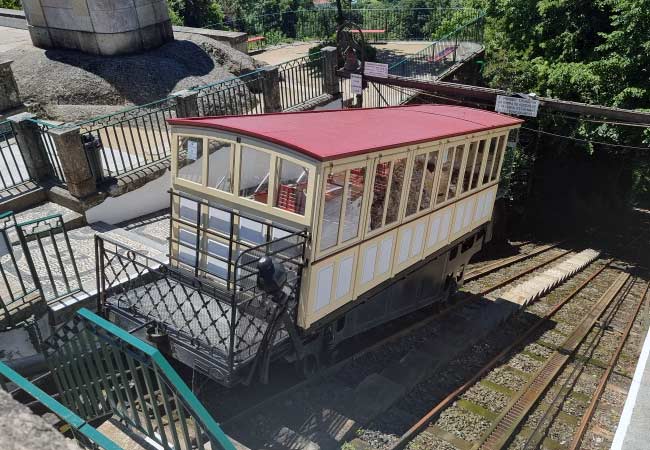
The Funicular to the top of the Bom Jesus hill
A Walking Tour of Braga's Historic Centre
The walk through Braga's historic centre covers around 6 kilometres and takes roughly two to three hours at a comfortable pace. One of the things that makes Braga such a pleasant city to explore on foot is that the centre is almost entirely flat, a welcome contrast to Porto's relentless hills. Most of the route follows wide pedestrianised streets, so there's none of the squeezing past cars on narrow pavements that you get in other Portuguese cities.
For the full walking tour with detailed descriptions of every sight, see our complete Braga walking tour guide. What follows is a condensed version covering the route and highlights.
The Route
Your walk begins a few minutes from the railway station at the Arco da Porta Nova (1), Braga's grand 18th-century gateway into the historic centre. From here, turn right onto Rua Dom Frei Caetano Brandão to reach the Cathedral (2), the oldest in Portugal. It dates to 1089, predating the founding of the country itself, and inside you can trace centuries of rebuilding as heavy Romanesque pillars give way to Gothic columns and then chapels dripping in Baroque gilding.
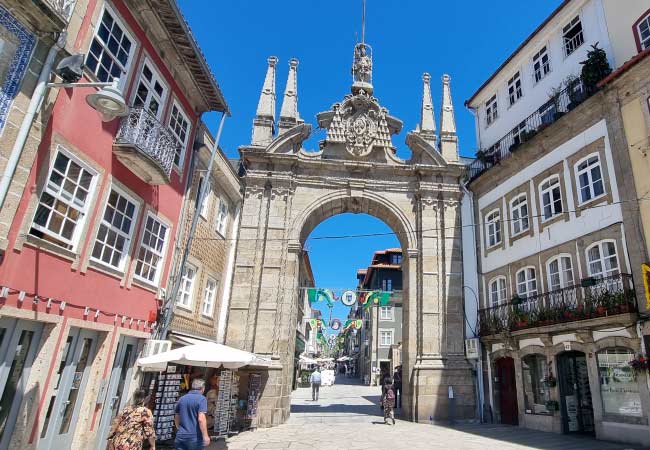
The Arco da Porta Nova welcomes visitors into the historic centre
Heading north brings you to the Câmara Municipal (3) on its handsome square, then on to the Convento do Pópulo (4), an Augustinian convent that now houses the city government. If you have time for one detour during the morning, make it the Palácio dos Biscainhos (5). The ground floor is paved with granite cobblestones because carriages once drove directly inside to drop off guests, and upstairs there's a room dedicated entirely to the ritual of drinking hot chocolate, a colonial luxury that was once more expensive than gold.
The route then turns east along Rua Dr. Justino Cruz, one of Braga's main pedestrianised shopping streets and a good spot to pause for coffee. This leads to the Jardim de Santa Bárbara (6), a small formal garden set against the medieval Gothic walls of the Archbishop's Palace. The contrast between the manicured flowerbeds and the weathered stone arches behind them makes it one of the most photographed spots in the city.
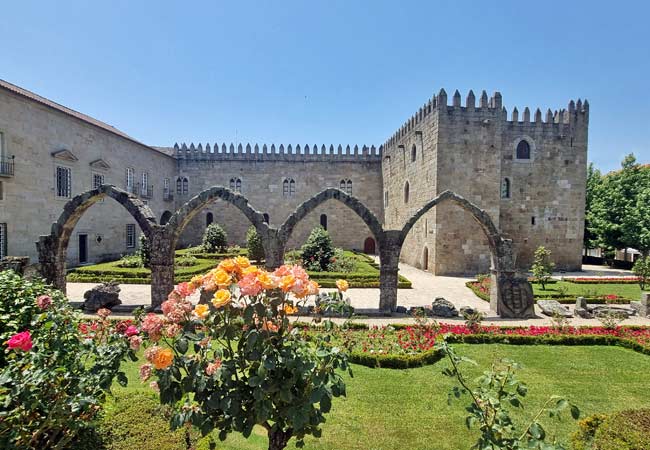
The Jardim de Santa Bárbara overlooking the Gothic eastern wing of the Paço Arquiepiscopal
From here you continue to Largo São João do Souto (7) and the distinctive Capela dos Coimbras, then loop west briefly to see the grand Largo do Paço (8) before heading east to the Praça da República, Braga's main square and social hub since the 14th century. Beneath the arches of the Arcada (9) you'll find Café Vianna, established in 1871 and one of Portugal's most storied cafés. The Convento dos Congregados (10) dominates one side of the square, a building that took over 250 years to complete.
As you continue, you'll reach the charming Largo São João do Souto (7), home to both the São João do Souto church and the distinctive Capela dos Coimbras.
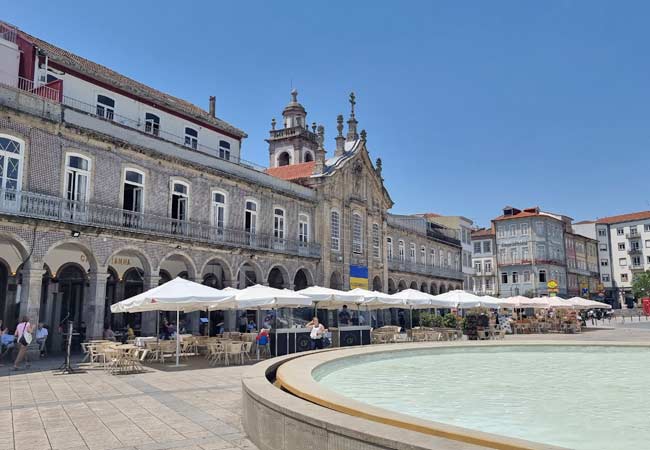
The Arcada has been the heart of Braga's shopping district since 1904
***Continue along Avenida da Liberdade to the Theatro Circo (11), a Belle Époque theatre from 1915 that is still a working venue, then turn into the Largo de Santa Cruz for the final cluster of sights. Three buildings compete for your attention here. The Palácio do Raio (12) is impossible to miss thanks to its vivid blue azulejo tiles, though the real story is the granite work underneath, designed by André Soares in 1752 with no two window pediments exactly alike. The Igreja de São Marcos (13) and Igreja de Santa Cruz (14) face each other across the square.
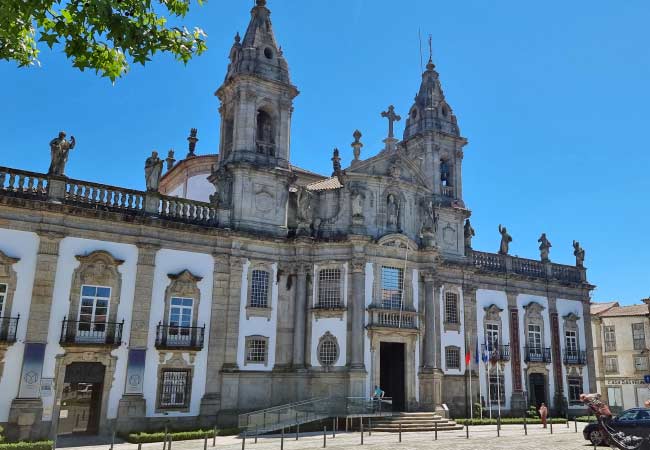
The splendid Igreja de São Marcos
Just off the square, a narrow cobbled alley leads to the Capela de São Bentinho (15), and this is one of those stops that rewards a pause. It's tiny, easily missed, and feels completely different from the grand churches you've been visiting all morning. This is where locals come, not tourists. You'll often see people stop briefly, touch the glass, cross themselves, and carry on with their day. There's something genuinely moving about a place of quiet devotion that has never become a museum.
A short walk further brings you to the Capela da Nossa Senhora da Torre (16), built into the city's old defensive walls. Climb the steps to the top for panoramic views across the historic centre. After a morning spent at street level, seeing everything laid out below you is a satisfying way to tie the walk together.
Lunch in Braga
From here, loop back to the Largo de São João do Souto, where the surrounding pedestrianised streets are full of restaurants. Four that I'd happily recommend:
• Antù Braga puts a modern twist on Portuguese classics and does it with real confidence.
• O Jacó, close to the station, serves wholesome traditional Portuguese food. My wife is Portuguese and this is one of her favourites in the city, which tells you everything.
• Dona Sé sits right next to the Cathedral and does Portuguese classics well, a reliable choice in a perfect spot.
• Bira dos Namorados specialises in burgers rather than traditional food, but the charming interior and quality make it worth mentioning for anyone wanting a change.
Bom Jesus do Monte
After lunch, head to Bom Jesus do Monte for the afternoon. The transport options, funicular, and stairway details are all covered in the sections above, so here's what to look out for once you're there.
The Baroque stairway was designed as a Sacred Mountain, allowing pilgrims who could never travel to Jerusalem to experience the Passion of Christ closer to home. Whether you walk up or down, the stairway splits into three distinct sections. The lowest winds through shaded woodland past chapels containing life-sized terracotta scenes of Christ's Passion.
Above that, the Stairway of the Five Senses is the famous Baroque zigzag, where fountains pour water from the eyes, nose, ears, and mouth of carved figures. The final section, the Stairway of the Three Virtues, leads to the church courtyard. There's a clever architectural trick at work throughout: the steps narrow as they rise, creating a forced perspective that makes the church appear larger from below.
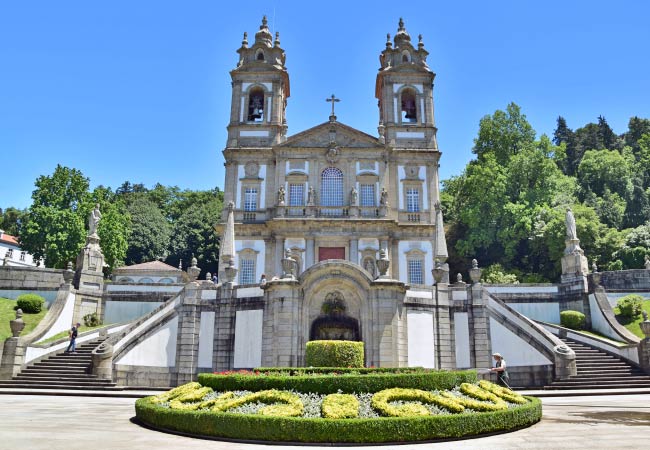
At the summit, the church houses an 18th-century organ and an altar crafted from Brazilian jasper. The surrounding park of old cedar and oak trees offers a cool escape, with grottoes, viewpoints, and a small rowing lake tucked among the woods. The views from the top stretch across the Minho valley and on a clear day reach considerably further.
When you're ready, descend by funicular and catch the bus or an Uber back to the city centre. The railway station is a short walk west, and you'll have seen the very best of Braga in a single, well-paced day.
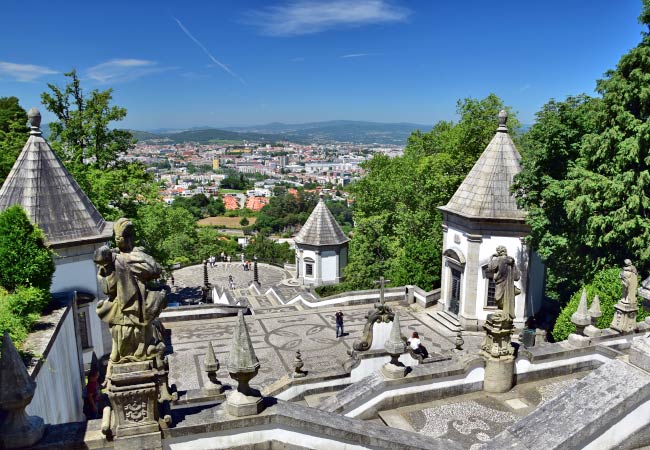
The Miradouro do Santuário do Bom Jesus
Our most popular guides to Braga and North Portugal


Expert Insight: I'm Philip Giddings. I've been visiting Portugal since 2001 and now live here, in the Graça district of Lisbon, with my Portuguese wife Carla, whose family go back generations. Carla first brought me to Braga and Northern Portugal on an early trip, proud to show me her country, and 25 years on we still travel here almost every month to see her aunt and extended family, who live within the region.
I've been writing the independent guides at Porto-North-Portugal.com since 2010, and the site is now my full-time work. Living in Portugal, married into a Portuguese family, and visiting Northern Portugal every month gives me a first-hand insight that many foreign blog writers simply don't have.
The site now has 174 guides on Braga and Northern Portugal. It takes no payment from tourist boards, tour operators, or attractions for inclusion, and is funded by affiliate commissions on tour bookings, which are disclosed on every page that contains them. Every practical detail (ticket prices, opening hours, bus routes, time-slot policies) is checked against official sources and verified in person on the walks I make through the city. Read my full story here.