Porto-North-Portugal.com
The best independent guide to Porto
Porto-North-Portugal.com
The best independent guide to Porto
The Torre dos Clérigos, Porto: an independent tourism guide for 2026
The Torre dos Clérigos is widely regarded as the symbol of Porto and is a must-visit attraction due to its stunning views from the top of the 75m-high tower.
This granite masterpiece held the title of Portugal's tallest building from its completion in 1763 until the late 19th century. Even today, it remains the tallest building in Porto's historic quarter, dominating the skyline with its Baroque elegance.
The tower's appeal lies in the breathtaking 360-degree panorama it offers from its summit. While the 240-step climb might seem daunting, the spectacular views of Porto's terracotta roofs, winding streets, and the Praça de Lisboa make every step worthwhile.
The €8 entrance fee (tickets available here) provides access to the Clérigos Tower, the Igreja dos Clérigos church, and the Clérigos Museum. Your admission to the church includes entry to the high-level gallery, offering a stunning view of Nicolau Nasoni's oval-shaped nave from above. The Clérigos Museum houses an impressive collection of religious artefacts and paintings from the Brotherhood of the Clérigos.
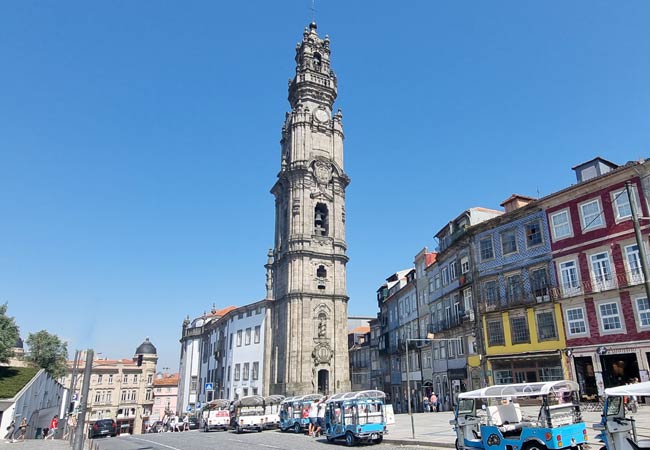
The Torre dos Clérigos stands higher than any other building in the historic quarter of Porto.
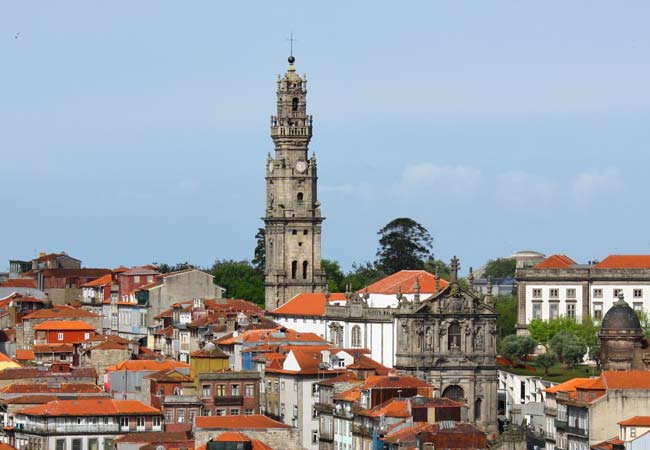
Its situation at the top of the hill also enhances the apparent height of the tower
Torre dos Clérigos tourist information
The Torre dos Clérigos is open daily from 9:00 to 19:00, and last entry is 30 minutes before closing time. During Easter and the summer peak season, the Clérigos Tower opens in the evenings between 19:00 and 23:00, which offers a stunning night-time view of the city.
The admission fee during daytime hours (09:00 - 19:00) is €8.00. This includes access to the tower, church, and museum. Discounted tickets are available for young people aged 11 to 18 at €5.00, while children under 10 enter free of charge.
Tickets for the Torre dos Clérigos can be purchased from GetYourGuide.com here.
Insight: Booking through GetYourGuide allows you to pay in your home currency, potentially saving on conversion fees for non-Euro users.
The summer evening admission (19:00 - 23:00), which is limited to the tower only, costs €5.00 for adults, with free entry for children under 10.
Visitors interested solely in exploring the church can enter free of charge, without the need to climb the tower.
For those wishing to attend Mass, the church offers a Sunday service at 21:30 and an English service every Saturday at 17:00.
As the most famous sight in Porto, the Torre dos Clérigos can get very busy during the day, especially between 11:00-12:00 and 13:30-15:00. It is advisable to visit early in the day (before 10:00) when the crowds are smaller and the weather is cooler.
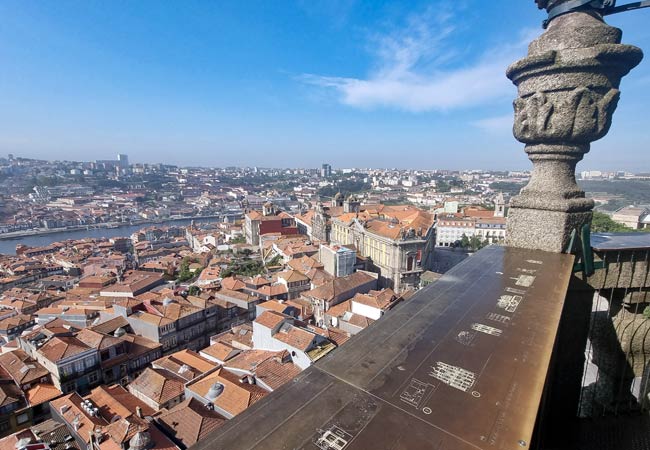
The view from the top of the Torre dos Clérigos looking southwards towards the Douro river
Insight: The iconic Ponte Luís I bridge can't be seen from the top of the tower, as Sé Cathedral hill blocks the line of sight to it.
Warning: It is 240 steps to the top of the tower, and it was never designed for large visitor numbers. Only visit if you are fit enough to climb to the top and are not affected by confined spaces, as the final section is very narrow. The narrow stairs get very hot in the summer months.
The official website for the Torre dos Clérigos is: www.torredosclerigos.pt
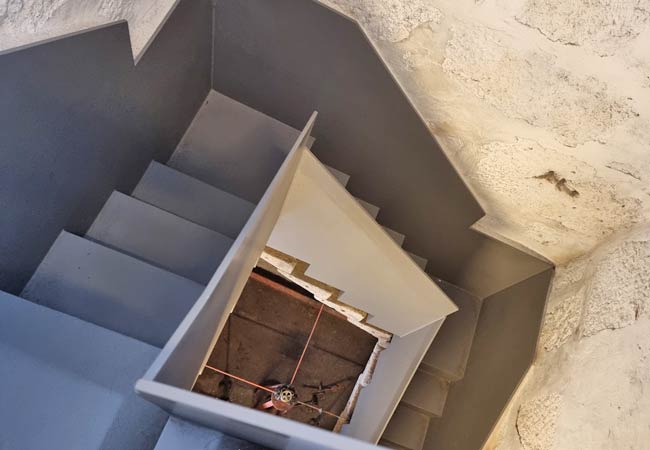
The narrow stairs leading to the viewing deck at the top of the tower
Evening and Off-Peak Visits to the Torre dos Clérigos
The Torre dos Clérigos offers a unique experience during its night-time opening hours (19:00-23:00 - summer only), providing visitors with a completely different perspective of central Porto and a more tranquil atmosphere.
The tower can become quite crowded during peak daytime hours. It can also be very draining climbing the 240 steps in the heat of the summer.
For a more enjoyable visit, consider visiting in the evening (after 20:00) when the weather is cooler and crowds are fewer. Summer visitors will find that climbing the tower at sunset is particularly rewarding, as they can witness the city's lights gradually illuminate the landscape below.
The Torre dos Clérigos
The Clérigos tower was constructed as a bell tower, and the bells still toll throughout the day, much to the surprise of tourists standing nearby. There are 49 bells in total, with the last ones added in 1995.
The Torre dos Clérigos was designed by Porto's most famous architect, Nicolau Nasoni, an Italian who spent the majority of his life constructing wondrous buildings in northern Portugal. In his later years, Nicolau joined the Clérigos order and is buried in an unmarked tomb in the church he created.
Interestingly, the tower was not built at the same time as the church. The Igreja dos Clérigos was completed in 1748, while construction of the Torre dos Clérigos only began in 1754. The original plans called for two symmetrical towers, but as funding came solely from the clergy and donations, the designs were scaled back.
The Brotherhood of the Clérigos was formed by combining three 17th-century charitable organisations whose purpose was to care for Porto's poor.
Upon founding the order, they were given a plot of land outside the city walls at the top of a hill. This hill, where the church stands today, was historically called the "Hill of the Hanged Ones", as it was used to bury criminals.
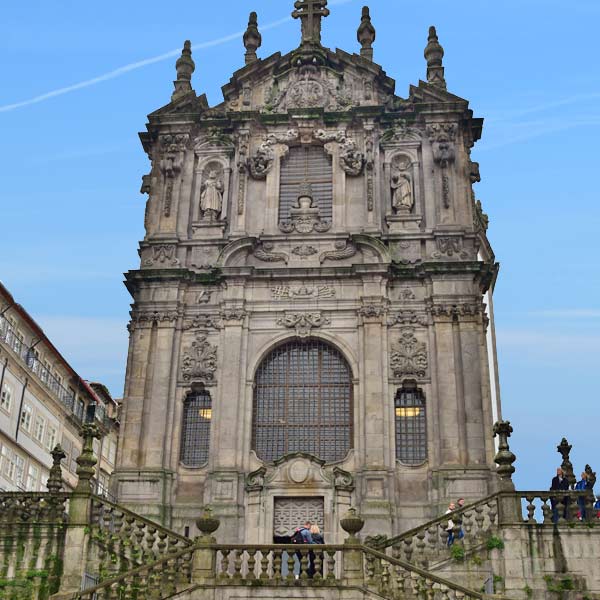
The front façade of the Igreja dos Clérigos church
The Igreja dos Clérigos
While the tower often steals the spotlight, the Igreja dos Clérigos itself is a masterpiece worthy of attention. This classical Baroque church, also designed by Nicolau Nasoni, was completed in 1748, six years before the tower's construction began.
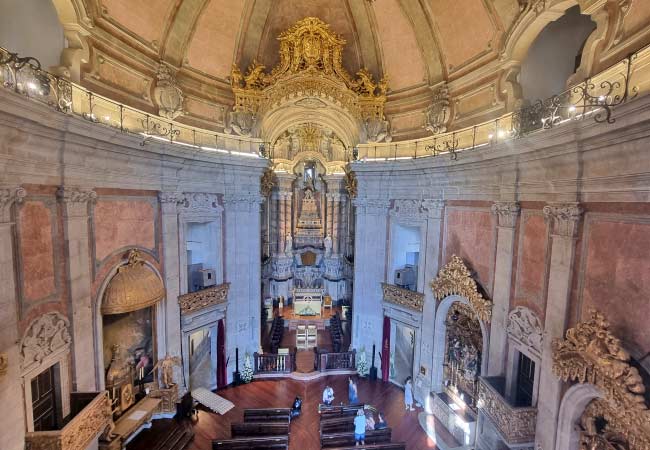
The church's façade is a stunning example of Baroque architecture, featuring intricate stone carvings that have been beautifully restored during a major renovation project completed in 2014. Upon entering, visitors are immediately struck by the unique oval-shaped nave, an architectural feature that not only creates a visually striking interior but also provides outstanding acoustics for the church's two pipe organs.
Inside, the church is adorned with gilt woodwork, marble altars, and beautiful frescoes that showcase the wealth and artistic tastes of 18th-century Porto. The main altar, created by Manuel Porto, houses a magnificent painting of the Assumption of the Virgin Mary. Several side chapels, each with its own unique decorations and religious artefacts, add to the church's rich visual appearance.
Despite its grand appearance today, the Igreja dos Clérigos has faced challenges throughout its history. In the 19th century, it fell into disrepair but was fortunately restored to its former glory in the early 20th century.
Your admission to the church includes entry to the high-level gallery, offering a stunning view of Nasoni's oval-shaped nave from above. This vantage point allows visitors to fully appreciate the architectural ingenuity and artistic detail that went into the church's design.
Adjacent to the church, the Clérigos Museum houses an impressive collection of religious artefacts and paintings from the Brotherhood of the Clérigos. These exhibits provide insight into the history and cultural significance of the church and its associated order.
Our most popular guides to Porto


Expert Insight: I'm Philip Giddings. I've been visiting Portugal since 2001 and now live here, in the Graça district of Lisbon, with my Portuguese wife Carla, whose family go back generations. Carla first brought me to Porto on an early trip, proud to show me her country, and 25 years on we still travel north almost every month to see her aunt and extended family, who live in the city.
I've been writing the independent guides at Porto-North-Portugal.com since 2010, and the site is now my full-time work. Living in Portugal, married into a Portuguese family, and walking Porto every month gives me a first-hand insight that many foreign blog writers simply don't have.
The site now has 174 guides on Porto and northern Portugal. It takes no payment from tourist boards, tour operators, or attractions for inclusion, and is funded by affiliate commissions on tour bookings, which are disclosed on every page that contains them. Every practical detail (ticket prices, opening hours, bus routes, time-slot policies) is checked against official sources and verified in person on the walks I make through the city. Read my full story here.