Porto-North-Portugal.com
The best independent guide to north Portugal
Porto-North-Portugal.com
The best independent guide to north Portugal
Guimarães - The best sights and attractions in 2026
By Philip Giddings · Last updated
Guimarães holds a unique place in Portugal's story. This is where the nation began, with Afonso Henriques, Portugal's first king, born and raised here before setting about forging an independent kingdom. That history is etched into every granite wall and cobbled lane, and it gives the city a character and authenticity that you can feel from the moment you arrive.
What I find makes Guimarães worth visiting, though, isn't just the history. Walk through the old town and you'll discover a city that wears its medieval heritage with pride, from the ancient stone castle on the hilltop to the Duke's palace and the meander of traditional streets filling the town below.
I've been visiting Guimarães since 2001, and it's one of those places I always look forward to showing friends and family, whether it's wandering the charming streets or taking the cable car up to Penha on a sunny spring day.
This guide covers what I regard as the best sights of Guimarães, from the famed landmarks to the lesser known. If you're here for a day trip from Porto or staying longer to explore the surrounding region, there's far more to discover than you might expect.
Related articles: Guimarães introduction - Day trips from Porto
The best of Guimarães
Here are the highlights of Guimarães, the sights I believe should not be missed during a visit. Below this section is an interactive map to help plan your trip, followed by detailed descriptions of each sight.
Castelo de Guimarães
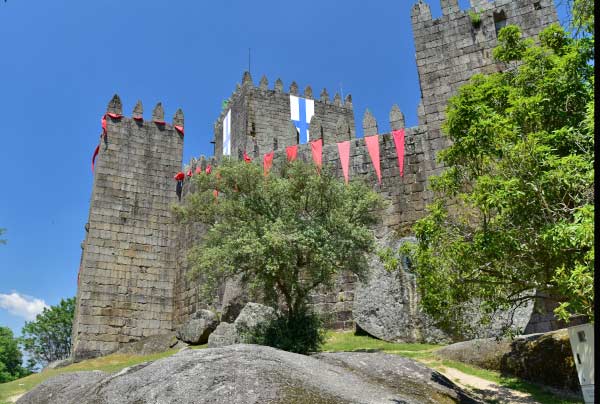
The hilltop castle where Portugal's first king, Afonso Henriques, was born in 1110. Climb the 28-metre keep for some of the best views across the city.
Paço dos Duques de Bragança
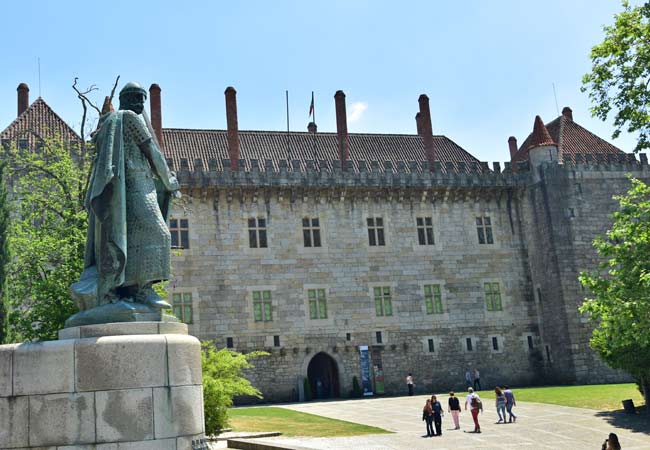
A 15th-century palace built in a style more Burgundian manor house than Portuguese. Over 60 rooms filled with tapestries, weapons, and period furniture, plus it still serves as an official presidential residence.
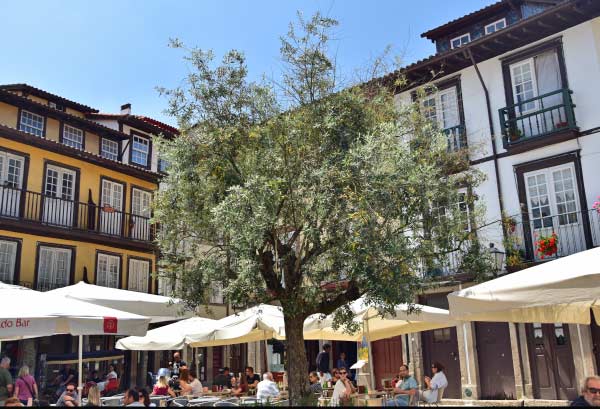
Largo da Oliveira
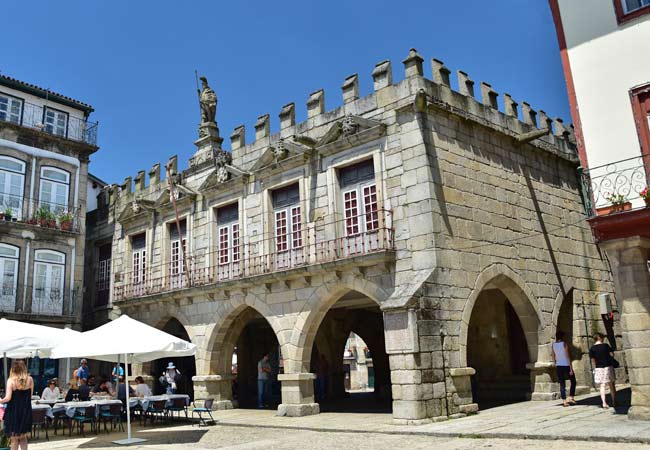
The centrepiece of the old town, a medieval square framed by the old town hall, a 14th-century Gothic shrine, and the olive tree that gave the square its name.
Igreja de Nossa Senhora da Oliveira
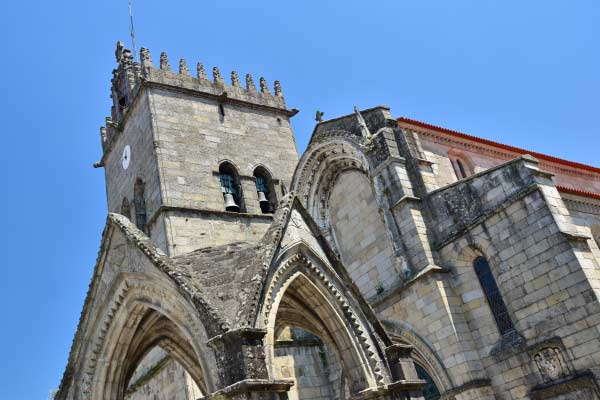
A Gothic church with roots going back to 950, home to one of Portugal's finest medieval silver altarpieces. The adjoining monastery now houses the Museu de Alberto Sampaio.
Muralhas de Guimarães
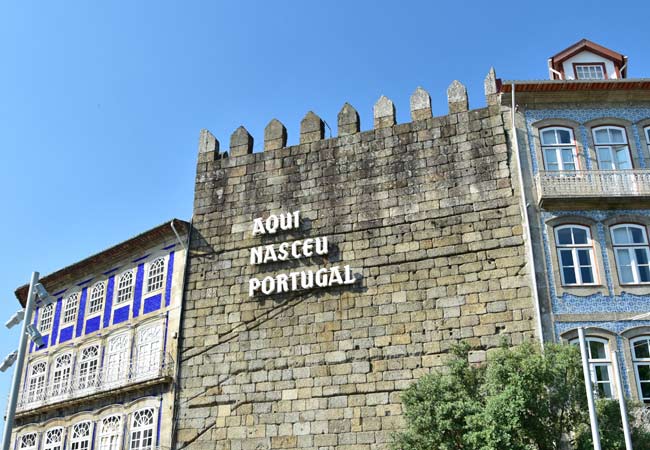
The best-preserved stretch of the medieval walls runs along Avenida Alberto Sampaio, where you can walk the old ramparts above the town.
Igreja de São Miguel do Castelo
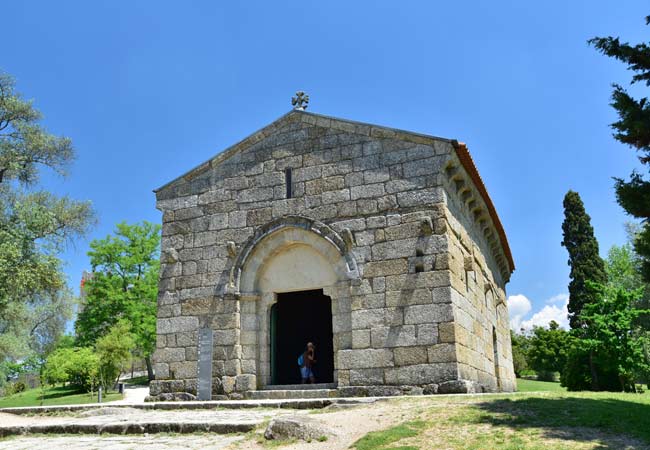
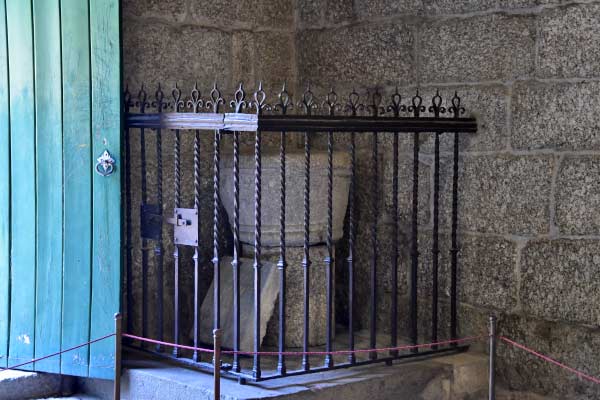
A tiny Romanesque chapel just outside the castle walls. The original baptismal font where Afonso Henriques was christened in 1106 is still inside.
Igreja dos Santos Passos
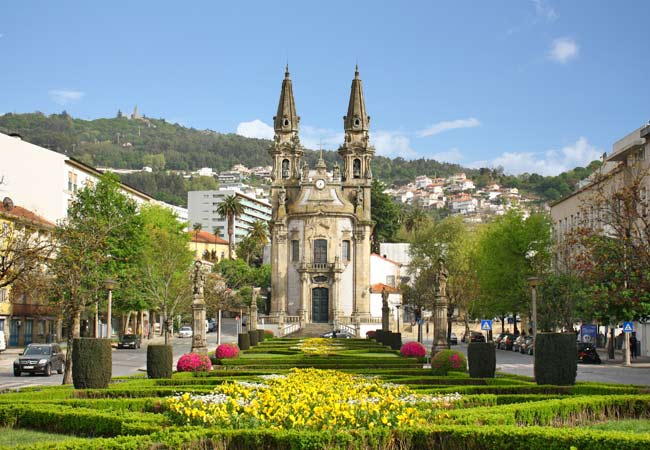
The twin-towered Baroque church that frames the end of the Jardim da Alameda. Its ornate façade is one of the most photographed sights in Guimarães.
Penha
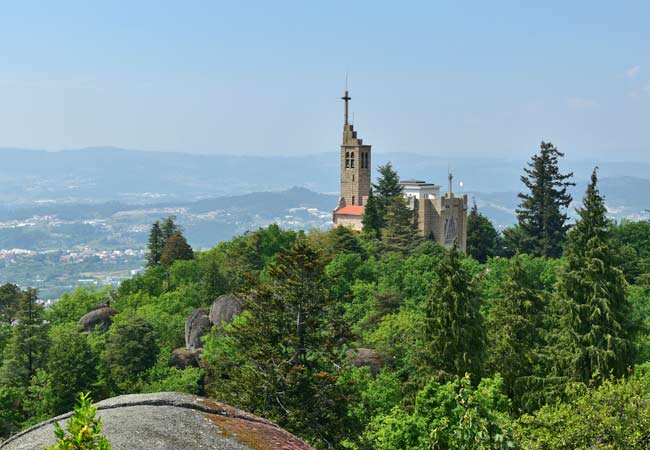
A forested hill south of the city, laced with walking trails through massive granite boulders. Take the cable car up and walk down, or spend a half day exploring the trails and the hilltop sanctuary.
Citânia de Briteiros (15 km from Guimarães)

The remains of an Iron Age hill fort with over 150 circular stone dwellings and paved streets, one of the best places in Portugal to see how pre-Roman Celtic communities lived.
The interactive map below highlights the main tourist attractions in Guimarães. (Note: Zoom out to view all of the markers for Penha hill.)
Legend: 1) Castelo de Guimarães 2) Paço dos Duques de Bragança 3) Igreja de Nossa Senhora da Oliveira 4) Igreja de São Miguel do Castelo 5) Santuário da Penha e Monte da Penha 6) Praça de São Tiago 7) Igreja de São Francisco 8) Convento de Santa Marinha da Costa 9) Igreja do Carmo 10) Padrão do Salado 11) Casa da Memória de Guimarães 12) Igreja dos Santos Passos 13) Antiga Câmara Municipal 14) Câmara Municipal de Guimarães 15) Teleférico da Penha 16) Convento de Santo António dos Capuchos 17) Basílica de São Pedro 18) Aqui Nasceu Portugal 19) Papa Pio IX Viewpoint
Sights of the Guimarães region 20) Citânia de Briteiros 21) Basílica de São Torcato 22) Monastery of Santa Maria de Pombeiro 23) Castelo de Arnóia 24) Parque Aquático de Fafe
How about a guided tour of Guimarães?
If this is your first visit to Guimarães, a small group tour is a great way to hear the stories behind the sights and remove the hassle of public transport. I've worked with GetYourGuide for the past seven years, and some of the best tours they offer for Guimarães include:
Sights of Guimarães
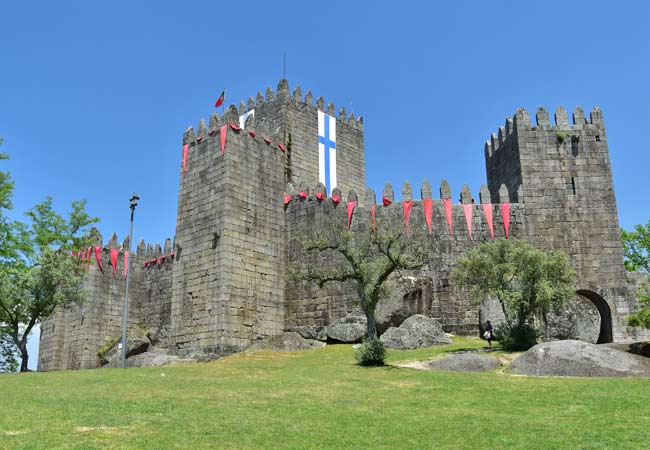
Castelo de Guimarães
Guimarães Castle was founded in 959 by Countess Mumadona Dias, one of the most powerful figures in the northwest of the Iberian Peninsula, to defend a nearby monastery from Viking and Moorish raids. Built directly onto the granite outcrop of Monte Latito, the natural rock forms part of the castle's foundations, something you can still see clearly today.
The castle's place in Portuguese history was sealed in 1110, when Afonso Henriques, the future first king of Portugal, was born here. But the real turning point came in 1128, when Afonso Henriques fought and defeated the forces of his own mother, Teresa of León, at the Battle of São Mamede just outside the castle walls. That unlikely family conflict set the course for Portuguese independence, and it's the reason the castle is known as the "Cradle of Portugal".
What stands today is a ring of solid stone walls with eight towers and a 28-metre square keep, added in the 13th century. Look closely at the keep and you'll notice the original entrance sits several metres above ground level, once only reachable by a removable wooden ladder as a last line of defence. The views from the top are worth the climb.
For centuries the castle was neglected, even serving as a prison at one point, and there were serious proposals to dismantle it for paving stones. It was only saved by its symbolic importance, and a major restoration in the 1940s returned it to something close to its medieval form.
Paço dos Duques de Bragança
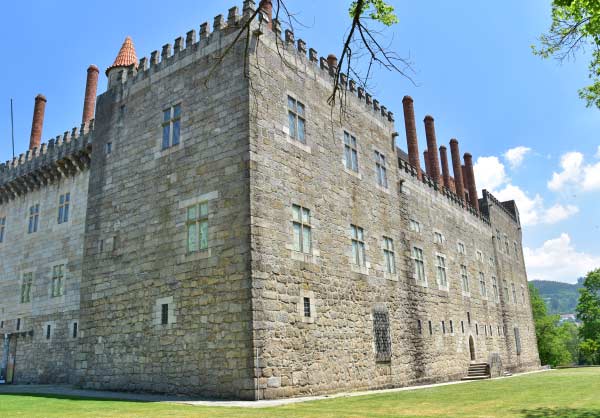
The Palace of the Dukes of Braganza was built in the 15th century by Afonso, the first Duke of Braganza, a nobleman who had spent time at the Court of Burgundy and wanted to bring that style back to Portugal. The result is unlike anything else in the country: 39 cylindrical chimneys inspired by northern European manor houses, battlements that give it the look of a fortified castle, and a Gothic cloister that feels almost monastic.
Inside, the standout rooms are the great halls, where the wooden ceilings were built using naval carpentry techniques, the beams shaped like the inverted hulls of ships. The Flemish tapestries depicting the Portuguese conquest of North Africa are among the most important in Portugal, essentially 15th-century war scenes told in thread. There's also a weapons collection that traces the shift from broadswords and chainmail to early firearms.
One room worth knowing about is the Sala dos Passos Perdidos, the Hall of Lost Steps, named for the visitors who would pace back and forth waiting for an audience with the Duke.
Like the castle above it, the palace was abandoned for centuries. Restoration in the 1930s was thorough, though not without controversy, as parts were reimagined to look grander than the original.
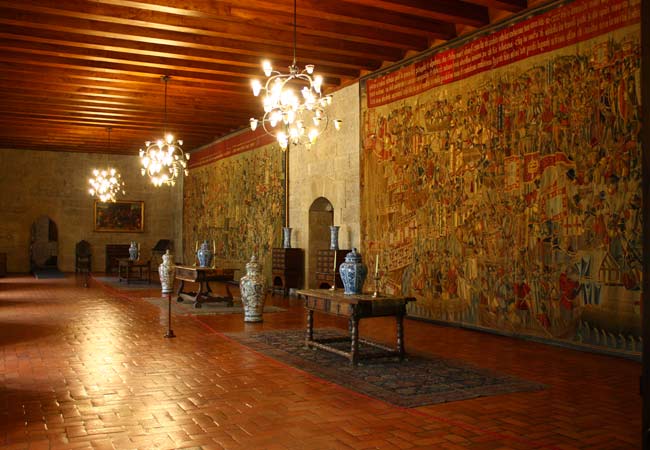
The 17th-century tapestries hanging in the Paço dos Duques de Bragança
Igreja de Nossa Senhora da Oliveira
The Church of Our Lady of the Olive Tree has stood at the heart of Guimarães since the 10th century, when Countess Mumadona founded a monastery on this site. The current Gothic structure dates from the 14th century, commissioned by King João I to celebrate his victory at the Battle of Aljubarrota in 1385.
The church's name comes from a story that's hard to resist. In 1342, a dead, dry olive trunk standing in the square, used to support a cross, suddenly burst into leaf. The miracle sealed the church's reputation, and a descendant olive tree still grows in the square today, replanted in 1985 to keep the legend alive.
Inside, the church is a layering of centuries. The lower sections of the bell tower and parts of the irregularly shaped cloister are Romanesque, remnants of Mumadona's original monastery, while the tower itself carries Manueline details from the Age of Discovery. The painted wooden ceiling in blues and golds and the gilded chapel woodwork are worth pausing for.
The adjoining Museu de Alberto Sampaio holds two remarkable pieces: a portable silver-gilt altarpiece that João I reportedly carried with him to Aljubarrota, and the padded battle tunic he wore that day, one of the best-preserved pieces of medieval military clothing in Europe.
Igreja de São Miguel do Castelo
This small granite chapel sits just outside the castle walls and is best known as the place where Afonso Henriques was baptised, likely around 1111, though the traditional date of 1106 still appears on most signs. The original stone baptismal font is still inside, its bronze cover added in the 19th century to stop visitors chipping off souvenirs.
Built from the same local granite as the castle, the chapel looks almost military: tiny slit windows that could double as defensive lookouts, thick walls, no decoration. The floor is paved entirely with tombstones of the warrior-nobles who fought alongside Afonso Henriques at São Mamede, some marked only with carved broadswords where names have been lost.
Like so much of Guimarães, it spent centuries neglected, at one point used as a hay store, before being restored when 19th-century Romanticism revived interest in Portugal's founding story.
Muralhas de Guimarães
The city walls tell the story of Guimarães growing from a hilltop fortress into a proper medieval town. The first walls enclosed the upper town around the castle, but as the merchant population grew, a second, larger loop was built in the 13th and 14th centuries under King Dinis to stitch together what had been two separate and often rival communities: the castle town and the monastery town.
The most recognisable section is the Torre da Alfândega, which carries the inscription "Aqui Nasceu Portugal" (Portugal was born here) and has become the unofficial logo of the city. Much of the rest was pulled down in the 1800s when the walls were seen as an obstacle to modern traffic, the stone reused for the very streets you walk on today.
The best-preserved stretch runs along Avenida Alberto Sampaio, where you can walk the ramparts and look down at the backs of medieval houses that grew into the walls over the centuries.
Monte da Penha and Santuário da Penha
Monte da Penha is the perfect counterpoint to a morning spent in the old town. This forested hill south of Guimarães is covered in ancient chestnut and oak trees, with walking trails winding between massive granite boulders that have been shaped by erosion into strange, rounded forms. Over the centuries, locals have carved steps into some of the rocks and turned small caves into shrines and picnic shelters.
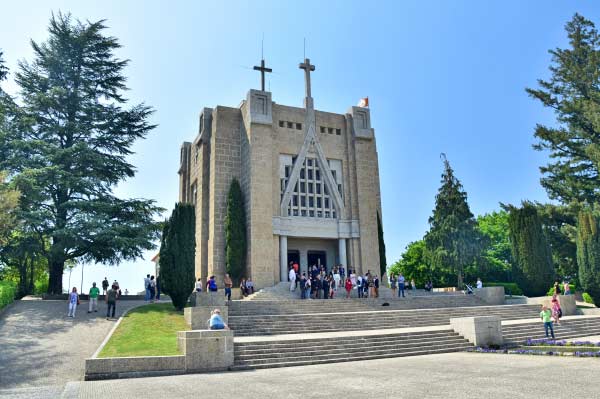
The hilltop sanctuary is an unusual building. Designed by architect José Marques da Silva and constructed between 1930 and 1947, it was built from the same grey granite as the surrounding boulders, so from a distance it looks almost like part of the mountain itself. Up close, the clean Art Deco lines and sharp geometry are striking, nothing like the Baroque churches down in the city. Inside, the stained-glass windows by João de Sousa Araújo fill the granite interior with colour when the light is right.
Near the summit, a statue of Pope Pius IX marks one of the best viewpoints, with an unobstructed view down to Guimarães Castle far below. There's also a small whitewashed chapel dating from 1702, a reminder that people were making pilgrimages up this hill long before the sanctuary was built.
Teleférico da Penha
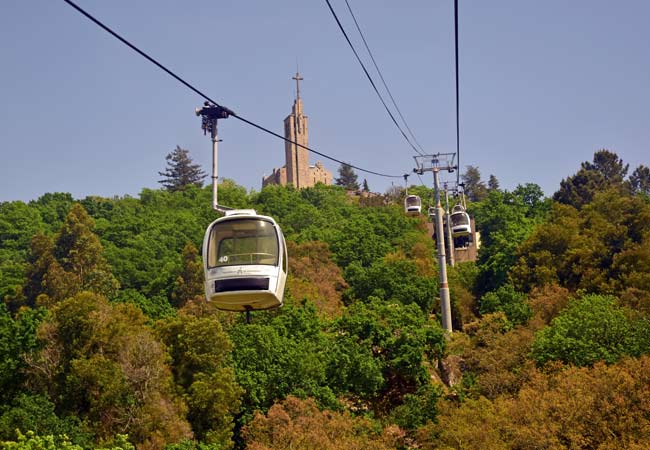
The Teleférico da Penha was Portugal's first cable car when it opened in 1995 and remains the easiest way up the mountain. The 1.7-kilometre ride climbs 400 vertical metres in about seven to ten minutes, taking you from the medieval streets of the city to the forested summit. A single journey costs €5.00 or a return €10.00.
Just keep an eye on the closing time, otherwise it's a long walk downhill, as I found out the hard way one evening before the convenience of Uber had arrived in Portugal.
Convento de Santa Marinha da Costa
Tucked into the slopes of Penha Hill and largely hidden from the city below, this former monastery is one of Guimarães' most rewarding detours. It was founded in 1154 by Queen Mafalda, wife of Afonso Henriques, who according to legend vowed to build it after surviving a difficult childbirth, dedicating it to Santa Marinha, patron saint of expectant mothers.
The building layers centuries of history. The oldest archways show Mudéjar brickwork, a rare Moorish influence this far north, while the corridors are lined with monumental 18th-century azulejo panels depicting the life of St. Augustine, with near life-sized figures designed to humble the monks who passed them daily. In the formal gardens, a Baroque water staircase echoes the design of Bom Jesus in Braga, with the sound of trickling water following you through the terraces.
A fire in 1951 gutted much of the interior, though remarkably the tile panels survived almost intact. The rebuilding and eventual conversion into a pousada in the 1970s was handled by Fernando Távora, one of the founders of the Porto School of architecture, who kept the scars of the old monastery visible while adding modern comforts. You don't need to be a guest to visit the cloisters, gardens, and church, and from the grounds you get one of the best framed views of Guimarães Castle below.
Padrão do Salado
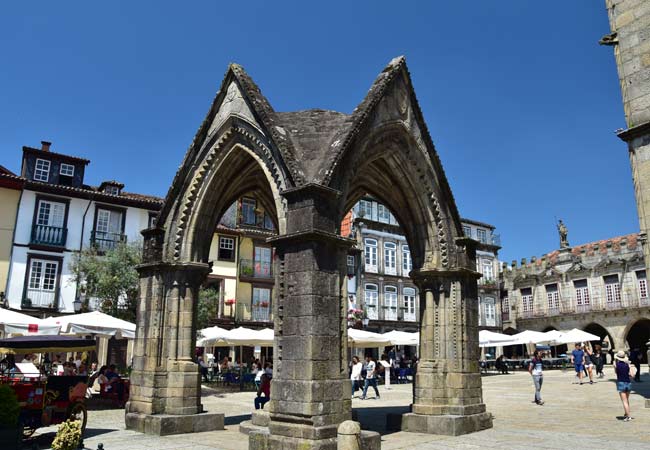
The Padrão do Salado stands directly in front of the Igreja de Nossa Senhora da Oliveira and is easy to walk past without giving it a second look. But this small Gothic canopy, erected in 1342, is one of the few surviving commemorative porches in Portugal.
King Afonso IV commissioned it to mark both his victory at the Battle of Salado and the miracle of the olive tree. Four pointed arches meet at a central cross (a 16th-century Manueline replacement, recognisable by its rope-like carving), and if you look closely at the pillar capitals you can pick out tiny weathered carvings of heads and foliage representing different social classes. It was designed as an open-air shrine where pilgrims could pray without entering the church, and for centuries it doubled as the official meeting point for the city's guilds and merchants.
Museu de Alberto Sampaio
The museum occupies the old monastery buildings adjoining the Igreja de Nossa Senhora da Oliveira, and its two headline pieces are covered in that section: João I's battle tunic from Aljubarrota and the portable silver-gilt altarpiece. But there's more here than those two items suggest.
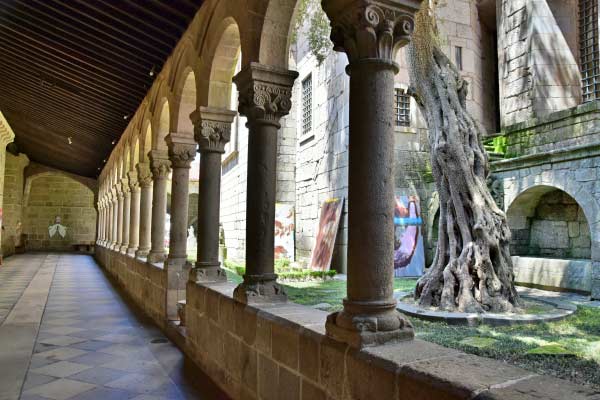
The setting itself is part of the appeal. The cloister is trapezoidal rather than the usual perfect square, squeezed into the medieval street plan, and the columns are worth a close look as each capital is carved with different beasts, biblical scenes, and foliage, no two alike, the individual signatures of 13th-century stonemasons.
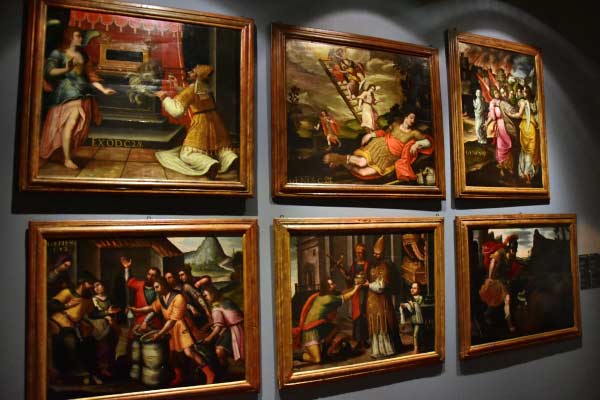
Inside, the collection draws from churches and convents across the region that were suppressed or fell into ruin during the 19th century, making this essentially a rescue centre for northern Portugal's lost religious art. Highlights include limestone saints from the 14th and 15th centuries that still carry traces of their original painted colour, and a room of processional silver crosses that traces the shift from heavy Romanesque forms to the delicate Manueline style. In the former Chapter House, 16th-century frescoes uncovered during restoration work are worth seeking out.
Largo do Toural
The main square of Guimarães sits just outside where the medieval walls once stood, and its name gives away its origins: "Toural" comes from touro (bull), a reminder that this was once a dusty cattle fair and bullfighting ground. Today it's an elegant open space lined with symmetrical 18th-century façades built after the old walls were pulled down.
The 2012 redesign added some clever details worth knowing about. The basalt and quartz paving is actually a topographic map of the historic centre, and white marble lines set into the ground trace the exact footprint of the demolished medieval walls. The 16th-century fountain at the centre was removed in 1873 and only returned during the renovations, nearly 140 years later.
Sights of the Guimarães region
Citânia de Briteiros
Fifteen kilometres north of Braga, the hilltop ruins of Citânia de Briteiros are what's left of a Celtic settlement that was home to perhaps a thousand people before the Romans arrived. Over 150 circular stone houses survive, arranged not randomly but in walled family compounds connected by paved streets, a layout that suggests a society far more organised than the word "hill fort" implies.
The site's most famous object is the Pedra Formosa, an elaborately carved granite slab that formed the entrance to a ritual bathhouse. The opening is so small that anyone entering had to crawl through on hands and knees, likely as a deliberate act of passage or purification. The original is now in the Museu Martins Sarmento in Guimarães, named after the 19th-century archaeologist whose careful excavation of Briteiros set a standard for the field in Portugal.
What I find most interesting about the site is how much still works. The stone drainage channels cut into the streets over two thousand years ago still carry rainwater downhill after a storm. And if you crouch by a doorway, look for the carved solar symbols on the frames, protective markings that connect this quiet hilltop in northern Portugal to Celtic traditions found right across pre-Roman Europe.
Igreja de São Torcato (7 km from Guimarães)
This basilica took nearly a century to build, from 1825 to 1910, and you can read that timeline in the stonework. The foundations are Neoclassical, but as your eye moves upward the style shifts through neo-Manueline and Romantic flourishes, the work of generations of masons whose slight variations in carving and stone colour are still visible.
The reason most people visit is inside: the incorrupt body of São Torcato, a bishop reportedly martyred by the Moors in 719 AD, displayed in a glass-sided reliquary dressed in liturgical vestments that are still periodically changed. It's the kind of thing that's either deeply moving or deeply unsettling depending on your disposition. Nearby, a room of ex-votos, wax body parts, photographs, and letters from those who believe the saint intervened for them, offers a raw window into Portuguese folk devotion that you won't find in any museum.
Every July the plaza outside fills with thousands of pilgrims for the Romaria de São Torcato, one of the oldest traditional pilgrimages in northern Portugal.
Caldas das Taipas (6 km from Guimarães)
A small spa town on the River Ave whose thermal waters have been drawing visitors for nearly two thousand years. The Romans were here first, and a granite altar dedicated to Emperor Trajan dating from 103 AD still survives, essentially a 1,900-year-old endorsement of the waters. Ruins of the original Roman bathhouse, with its brick-lined pools and tanks, were uncovered during 19th-century excavations.
The modern spa facilities date from that same period, built around sulphur-rich springs that emerge at 32°C and were historically recognised as a treatment for skin conditions. The riverside park along the Ave is worth a wander in its own right, stretching to around 20 hectares with a river beach that locals have been using as a summer gathering spot for generations.
Our most popular guides to Guimarães and North Portugal


Expert Insight: I'm Philip Giddings. I've been visiting Portugal since 2001 and now live here, in the Graça district of Lisbon, with my Portuguese wife Carla, whose family go back generations. Carla first brought me to Guimarães and Northern Portugal on an early trip, proud to show me her country, and 25 years on we still travel here almost every month to see her aunt and extended family, who live within the region.
I've been writing the independent guides at Porto-North-Portugal.com since 2010, and the site is now my full-time work. Living in Portugal, married into a Portuguese family, and visiting Northern Portugal every month gives me a first-hand insight that many foreign blog writers simply don't have.
The site now has 174 guides on Guimarães and Northern Portugal. It takes no payment from tourist boards, tour operators, or attractions for inclusion, and is funded by affiliate commissions on tour bookings, which are disclosed on every page that contains them. Every practical detail (ticket prices, opening hours, bus routes, time-slot policies) is checked against official sources and verified in person on the walks I make through the city. Read my full story here.