Porto-North-Portugal.com
The best independent guide to north Portugal
Porto-North-Portugal.com
The best independent guide to north Portugal
Porto to Braga: an independent travel guide for 2026
By Philip Giddings · Last updated
Braga is known as the religious centre of Portugal, and it is one of my favourite cities to visit in the north, rich in history and full of wonderful sights.
The city makes for an enjoyable day trip from Porto and is also a popular base for exploring the northern regions of Portugal. Just outside the city lies the Bom Jesus do Monte church, with its magnificent Baroque stairway, which is rightly considered one of the finest tourist attractions in northern Portugal.
Braga is easily accessible from Porto, as it is connected by a regular and inexpensive railway. Having visited Porto since 2001, I have taken this train journey countless times, travelling with both my older parents and my young nephew, and I recommend it to any friends who are heading to Braga for a day trip or longer stay.
This guide shares my personal knowledge along with station information, fare details and other useful tourist insights, to make the journey as easy as possible for you. The final section of the article explains how to travel from Porto Airport to Braga.
Related articles: Braga guide
Porto to Braga: An overview
Braga is located 42km to the north of Porto, and the fastest method of travel between the two cities is by car. I find having a car is particularly useful for a day trip to Braga, as it eliminates the need to catch the bus to the Bom Jesus church, which is situated 5km outside of Braga city centre.
If you don't have a car, the train is the recommended means of travel, providing a frequent and inexpensive service to the city. In Porto, the train departs from São Bento train station, which is conveniently located in the heart of the city and close to the main tourist areas.
The train to Braga is part of the urban Porto train network, which means that there are many stops along the way, and a comparatively long journey for the distance. I personally find this one of the most uneventful train journeys from Porto, as the route passes through nondescript villages and countryside, offering little in terms of scenic views, unlike the stunning Linha do Douro.
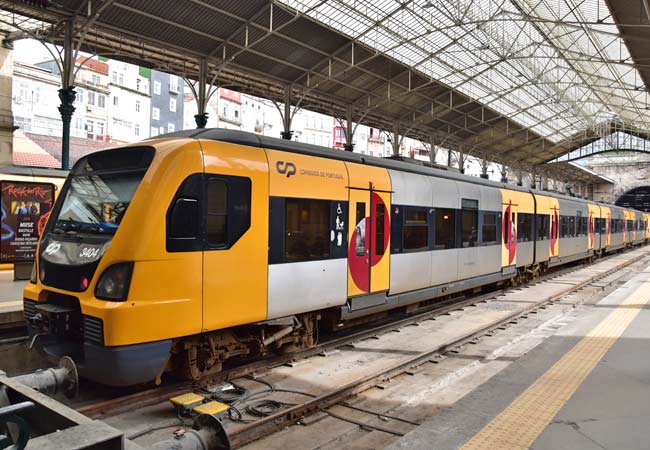
The train to Braga waiting at the São Bento train station
Porto to Braga by train
The train to Braga is operated by Comboios de Portugal (CP), the national train company, and it is a service I have used countless times over the years.
A single ticket from Porto to Braga costs €3.60 for adults and €1.80 for children. There are no return tickets, so a return fare is the price of two singles: €7.20 for adults and €3.60 for children. The journey distance falls within the "Zone 8" pricing bracket of the Porto urban train lines. All fares must be loaded onto a rechargeable smart card known as the “Siga” card.
This card costs €0.50 and is purchased the first time you buy a ticket at São Bento or Campanhã station. If you plan on taking another day trip (such as to Aveiro or Guimarães), keep the card and simply "top it up" at the machine to save the €0.50 fee next time.
Insight: You must validate your card before every journey by touching it against the yellow or red pedestals located on the station platforms. For Siga cards, validation must occur no more than 10 minutes before your train's scheduled departure. If you validate too early or forget entirely, your ticket is technically invalid, and you may be fined during an inspection.
The train from Porto to Braga is an urban service, and therefore seats cannot be reserved. Tickets can be purchased online from the Comboios de Portugal website (up to 3 months in advance) or from the ticket office and ticket machines at São Bento train station.
Insight: While some third-party apps may offer to sell these tickets, they will charge additional booking fees, and may only offer the much more expensive intercity train services.
Braga is the final station on the railway line, and depending on the service, the journey takes either 54 or 71 minutes. The trains that operate between Porto and Braga are modern, clean, and well-maintained.
The route is also safe to travel late at night. In all my years of travelling this route, I have never heard any reports of it being unsafe, even on the latest services. The Braga train is suitable for passengers with reduced mobility, as the platforms are at the same height as the carriage doors.
There are twenty daily departures, with seven extra services Monday to Friday. The first daily departure from Porto São Bento is at 06:40 (or 06:05 Monday to Friday), and the last return service from Braga departs at 23:30 (correct as of March 2026). For the latest timetable, please see the CP website:
www.cp.pt/
(The link opens a PDF, which may download on certain mobile phones)
Insight: Porto Campanhã and Braga lie along the main express network of Portugal, and the route is served by the Alfa Pendular train, which takes only 38 minutes to reach Braga. The downside is that tickets are significantly more expensive (€16–€22 depending on class and availability) and seats must be reserved in advance. Because of the higher prices, few tourists consider it, but if you value luxury and speed, this is a good option. However, for the cost of two tickets, you are approaching the price of an Uber fare, which remains the preferred choice for many due to its door-to-door convenience.
The interactive map below shows the route of the train from Porto to Braga and marks all of the stations on the faster 54-minute route. (Note: zoom in or out to see all of the points)
Key: 1) São Bento station 2) Campanhã station 3) Braga station 4) Braga bus station
How about a guided tour of Braga?
If this is your first visit to Braga, a small group tour is a wonderful way to discover the city and ensure you don't miss any of the key sights. I have worked with GetYourGuide for the past seven years, and some of the best tours they offer for Braga include:
Porto and Braga train stations
All urban trains to Braga depart from São Bento train station (GPS 41.145, -8.610) (link to Google Maps). Conveniently located near Porto's main tourist areas, the station is a short walk from the Ribeira district and is served by the D (yellow) metro line, the main north-south route.
São Bento station offers standard facilities, including an ATM, coffee shop, luggage lockers, ticket offices, and a small waiting room. The ticket machines at the station provide instructions in all common European languages and accept both cash and card payments. Be aware that the main ticket office in São Bento train station can become very busy, particularly during rush hour.
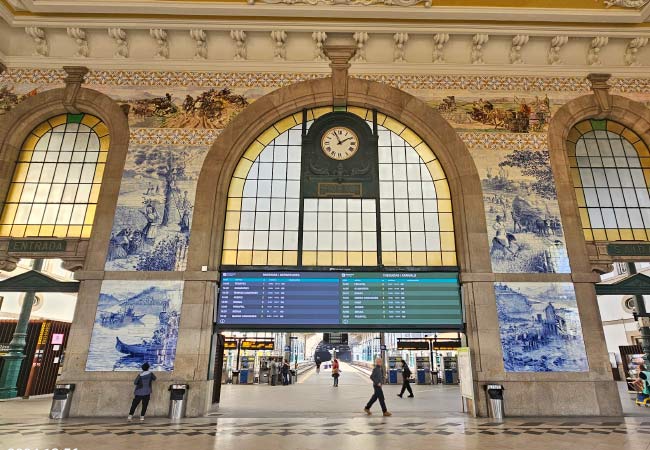
While passing through São Bento train station, don't miss the stunning azulejo tile paintings adorning the waiting room walls. Dating from 1907-1913, the tiles reflect the eras before and after the 1910 Portuguese revolution. The classic blue and white tiles predate the revolution, while the coloured tiles, introduced after the revolution, were considered modern and progressive, symbolising the newly formed republic in 1911.
If you are already staying near Campanhã, or arriving by intercity train from Lisbon or Coimbra, you can also board the Braga train here (GPS: 41.150, -8.584). However, I always recommend starting from São Bento. It is a small terminus station, so all platforms are just a short walk from the ticket hall, and trains tend to be waiting well before departure. Campanhã is a much larger through station, where you need to navigate tunnels or bridges to reach your platform, and trains arrive with less time to spare.
Braga train station is also a terminus, situated on the city's western side (GPS 41.548, -8.4344). Like São Bento, it is a small and easy station to navigate, with all platforms accessible directly from the ticket hall. From the station, it's a pleasant 500m walk to the historic centre along Rua Andrade Corvo, which leads to the Arco da Porta Nova.
Uber and Bolt between Porto and Braga
The ride-hailing apps Uber and Bolt offer a convenient alternative to public transport and are surprisingly affordable for the journey between Porto and Braga. These services are particularly useful when travelling with children or in a group of four, as they provide a comfortable and direct door-to-door service.
The biggest advantage of Uber or Bolt is the flexibility they offer at the end of the day. You are not tied to train departure times and can leave whenever you are ready. You could also be collected directly from the Bom Jesus do Monte, saving you the trip back into the city centre. After a long day of sightseeing, the comfort of a direct ride back to Porto is hard to beat. I discovered this first hand when I took my brother and his family for a day trip to Braga. When the children were tired, we simply booked an Uber XL and they fell asleep in the car, which was far easier than navigating the train home.
The base fare for a ride from central Porto to Braga is approximately €43. However, the exact fare may vary depending on factors such as demand, traffic conditions and time of day. It is often easier to hail an Uber or Bolt during mid-morning when demand is low. Later in the day, especially during rush hour, fares can increase by up to 50%, with longer wait times to find available drivers. There are also many more drivers available in Porto than in Braga, so hailing a ride will always be easier from the Porto end.
While Uber tends to be slightly more expensive than Bolt, I find it generally offers a higher standard of vehicles and drivers, and I would recommend opting for Uber when travelling between Porto and Braga. I also recommend booking a "comfort" level car through either app. This costs approximately 15% more than a standard fare but ensures a more spacious and comfortable vehicle. The higher fare also attracts more drivers, which can be helpful during peak hours, as comfort drivers can accept both comfort and regular fares but will typically prioritise comfort rides due to the higher earnings.
If you plan to use Uber or Bolt during your stay in Portugal, I would recommend downloading the app, completing the registration process and familiarising yourself with its features before your trip. As fares are charged in euros, it is advisable to link the app to a bank account that does not impose fees for foreign currency transactions, especially if your home currency is not the euro.
Porto airport to Braga
If you are heading straight to Braga from Porto airport, there is no need to travel into central Porto to catch the train. The two best options are Uber/Bolt or the Get Bus airport service.
Uber or Bolt is the fastest and most convenient option, with a fare of approximately €35 for the direct journey. Based on my experience, fares tend to be lower during mid-morning and higher during rush hour, so the exact price will vary depending on when you land.
The Get Bus service is a surprisingly affordable alternative, with a single ticket costing just €9. The journey takes approximately 50 minutes, and the bus departs from Stop D outside the terminal building. Tickets can be purchased directly from the driver using cash. There are eight daily departures, with eleven on weekdays. For the latest timetables and to purchase tickets online, please visit the Get Bus website: www.getbus.eu
Although bus departures are limited, this option is significantly more affordable than taking a taxi (which costs between €80–€100) and more convenient than taking the metro into Porto followed by a train to Braga.
In Braga, the Get Bus service terminates outside the bus station (GPS 41.555, -8.425), which is to the north of the city centre.
Our most popular guides to Braga and North Portugal


Expert Insight: I'm Philip Giddings. I've been visiting Portugal since 2001 and now live here, in the Graça district of Lisbon, with my Portuguese wife Carla, whose family go back generations. Carla first brought me to Braga and Northern Portugal on an early trip, proud to show me her country, and 25 years on we still travel here almost every month to see her aunt and extended family, who live within the region.
I've been writing the independent guides at Porto-North-Portugal.com since 2010, and the site is now my full-time work. Living in Portugal, married into a Portuguese family, and visiting Northern Portugal every month gives me a first-hand insight that many foreign blog writers simply don't have.
The site now has 174 guides on Braga and Northern Portugal. It takes no payment from tourist boards, tour operators, or attractions for inclusion, and is funded by affiliate commissions on tour bookings, which are disclosed on every page that contains them. Every practical detail (ticket prices, opening hours, bus routes, time-slot policies) is checked against official sources and verified in person on the walks I make through the city. Read my full story here.