Porto-North-Portugal.com
The best independent guide to north Portugal
Porto-North-Portugal.com
The best independent guide to north Portugal
A Walking Tour of Braga: a self-guided tour for 2026
Braga is one of those cities that surprises people. Often when I mention that it is the religious capital of Portugal, I'm met with a hesitant "is it really worth a day trip?" but after visiting, those doubts disappear completely.
Most people arrive expecting a quiet, church-heavy city, all cathedrals and convents, and find instead a place full of life. Thousand-year-old churches sit between busy café terraces, the Praça da República bustles with shoppers, and restaurants are packed with diners well into the evening. What I find makes Braga so enjoyable to explore on foot is that none of this history feels stuffy or museum-like. It's a living, working city that just happens to have an extraordinary past built into every corner.
I've been exploring northern Portugal since 2001, and Braga remains one of my favourite places to take first-time visitors. This walking tour follows the route I've used to show friends and family around the city, and it splits naturally into two halves. The morning takes you through the historic centre on a loop that passes the country's oldest cathedral, Baroque palaces, hidden chapels, and some of the prettiest squares in northern Portugal.
After lunch in the old town, where the best choice of restaurants is found, the afternoon heads out to Bom Jesus do Monte and its monumental Baroque stairway and hilltop church. Don't let the word "church" put you off. This is one of the most visually spectacular sights in the whole of northern Portugal, and I have yet to take anyone there who wasn't completely won over.
So let me guide you through a city that I love, on a route I know well.
Overview of the walking tour route
Below is an overview of the walking tour, followed by an interactive map of the route.
The walk begins at the Arco da Porta Nova, Braga's grand 18th-century gateway, just a few minutes from the railway station. From here you head straight to the Cathedral, a building that predates Portugal itself and contains nearly a thousand years of architectural history layered one period on top of another.
Heading north, you'll pass the Câmara Municipal on its handsome square before reaching the Convento do Pópulo, originally an Augustinian convent and now home to Braga's city government. If you have time for one short detour, the Palácio dos Biscainhos is worth the entry for its Baroque gardens and the wonderfully eccentric detail that carriages once drove directly inside to keep guests dry.
The route then turns east along Rua Dr. Justino Cruz, a busy pedestrianised street lined with shops and cafés, to the Jardim de Santa Bárbara. This small formal garden sits against the Gothic walls of the Archbishop's Palace.
From the garden you continue to Largo São João do Souto and the distinctive Capela dos Coimbras, then loop west briefly to see the grand frontage of the Largo do Paço before heading east to the Praça da República, Braga's main square and social hub since the 14th century. The square's Arcada building and the Convento dos Congregados set the scene as you continue along Avenida da Liberdade towards the final cluster of sights.
These last stops are some of the most striking. The Theatro Circo is a Belle Époque gem from 1915, still very much a working venue. Around the corner in Largo de Santa Cruz, the churches of São Marcos and Santa Cruz face each other across the square, with the unmissable blue-tiled Palácio do Raio alongside them. Just off the square, the intimate Capela de São Bentinho and the Capela da Nossa Senhora da Torre (with its rooftop views over the city) round off the morning walk before you loop back through the pedestrianised streets for lunch.
After lunch, head to Bom Jesus do Monte either by Uber (which I also use) or the bus that departs from the Avenida da Liberdade. From the base of the complex you can ride the historic funicular to the top or climb the famous Baroque stairway to the sanctuary at the summit. This is a surprisingly long and demanding uphill walk, especially in the heat of summer. At the summit explore the church, gardens, and viewpoints, and descend at your own pace before catching the bus back to the city centre.
Below is an interactive map of the walking tour with all the stops from this walking tour marked in order.
Legend: 1) Arco da Porta Nova 2) Sé de Braga 3) Jardim da Praça do Município
4) Convento do Pópulo 5) Palácio dos Biscainhos 6) Jardim de Santa Bárbara 7) Largo São João do Souto 8) Largo do Paço 9) Arcada 10) Convento dos Congregados 11) Theatro Circo 12) Palácio do Raio 13) Igreja de São Marcos 14) Igreja de Santa Cruz 15) Capela de São Bentinho 16) Capela da Nossa Senhora da Torre
Bom Jesus do Monte: 1) Elevador Bom Jesus do Monte 2) Santuário do Bom Jesus 3) Via Crucis 4) Miradouro do Santuário do Bom Jesus
Practical Details for the Walking Tour of Braga
The walking tour of Braga's historic centre covers around 6 kilometres in total, including the walk to and from the train station. Allow roughly two hours at a comfortable pace, though longer if you decide to go inside the Palácio dos Biscainhos (which can always be saved for the end of the day if energy is running low). Bom Jesus adds another kilometre or so on paper, but the hills and staircases make it feel considerably further.
The train station sits close to the edge of the historic centre, so you're into the old town within minutes of arriving. One of the things that makes Braga such a pleasant city to walk around is that the centre is almost entirely flat, a welcome contrast to Porto's relentless hills. Most of the route follows wide pedestrianised streets, so there's none of the squeezing past cars on narrow pavements that you get in other Portuguese cities. It actually feels calm and spacious, even during busier periods. My parents, who aren't the most adventurous walkers, took such a shine to the city on their first visit that they insisted on staying longer the second time around.
For getting out to Bom Jesus, buses run regularly from Avenida da Liberdade and the journey takes about twenty minutes. Uber and Bolt both operate reliably in Braga and are often the easier option, particularly if there are a few of you splitting the fare. Drivers can drop you at either the base or the summit, depending on whether you want to climb or descend the stairway.
Where to eat in Braga
There are plenty of excellent restaurants scattered through the old town, and finding somewhere good is rarely difficult. Four that I'd happily recommend:
• Antù Braga puts a modern twist on Portuguese classics and does it with real confidence.
• Jacó, close to the station, serves wholesome traditional Portuguese food. My wife is Portuguese and this is one of her favourites in the city, which tells you everything.
• Dona Sé sits right next to the Cathedral and does Portuguese classics well, a reliable choice in a perfect spot.
• Bira dos Namorados specialises in burgers rather than traditional food, but the charming interior and quality make it worth mentioning for anyone wanting a change of food.
Detailed Guide to the Walking Tour
Arco da Porta Nova
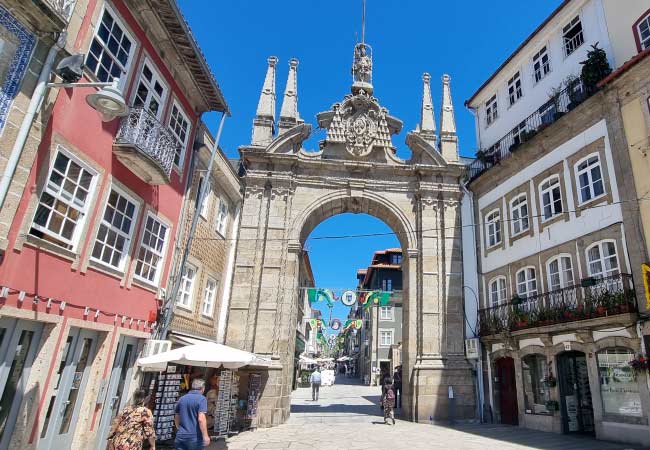
The walk begins a few minutes from the railway station at the Arco da Porta Nova, Braga's ceremonial gateway into the historic centre. The arch was redesigned in 1772 by André Soares, the self-taught architect whose work defines much of Braga's Baroque character, and it still carries the carved royal Portuguese coat of arms. For centuries this was the formal entrance to the city.
Sé de Braga (Cathedral)
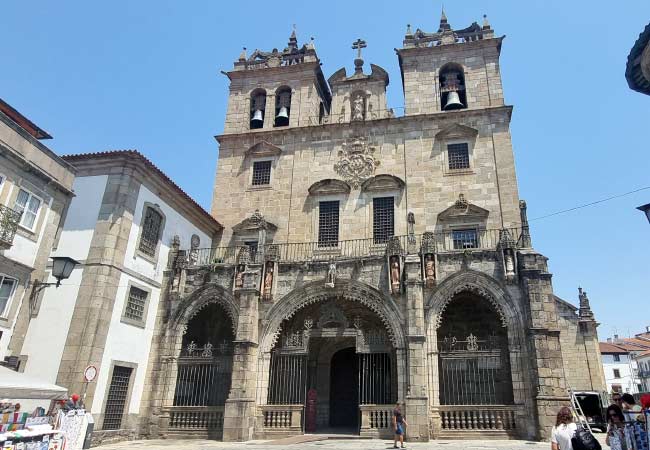
Turn right onto Rua Dom Frei Caetano Brandão and within a couple of minutes you'll reach the Cathedral, the oldest in Portugal. It dates to 1089, predating the founding of the country itself, and has been in continuous use for over 900 years. There's even a Portuguese expression, "Mais velho que a Sé de Braga" (older than the Cathedral of Braga), used to describe anything truly ancient.
From the outside it looks more like a fortress than a church, and that was deliberate. In the 11th century, cathedrals in this part of Portugal needed to be defensible. Inside, the centuries of rebuilding become clear as heavy Romanesque pillars give way to Gothic columns and then to chapels dripping in Baroque gilding. The highlight for many visitors is the pair of enormous gilded organs facing each other across the nave, built in 1737. Their horizontal trumpets project sound directly into the space with a piercing clarity that vertical pipes can't match.
If you have time, seek out the Capela dos Reis (Kings' Chapel), which houses the tombs of Count Henry and Dona Teresa, parents of Portugal's first king.
Câmara Municipal and Praça do Município
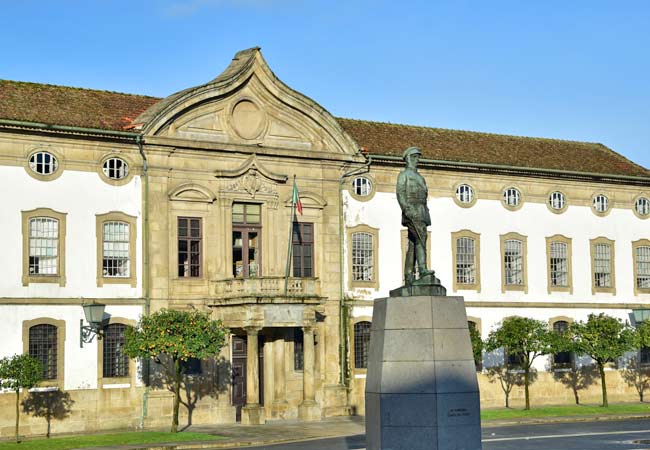
Heading north brings you to the Praça do Município, a handsome square with the Câmara Municipal (City Hall) as its centrepiece. The building was also designed by André Soares and is considered one of the finest examples of Baroque civic architecture in the region. In the centre of the square stands a fountain topped with a statue of St. Barbara, patron saint of protection against storms and lightning.
Convento do Pópulo
A short walk further north and you reach the Convento do Pópulo, an Augustinian convent that now serves as Braga's city government. The convent was deliberately named after the Basilica of Santa Maria del Popolo in Rome, a piece of spiritual branding that linked this corner of northern Portugal directly to the Catholic capital. The exterior is largely an 18th-century Neoclassical redesign, though the clock tower was added in 1906.
If you go inside, look for the blue and white azulejo tile panels along the noble staircase. They depict the life of St. Augustine with trompe-l'oeil architectural details so convincing they trick the eye into seeing three-dimensional pillars on a flat surface. The building later spent years as a military barracks after the dissolution of the monasteries in 1834, which probably explains why the heavy granite interiors survived so well rather than being stripped or remodelled.
Palácio dos Biscainhos (optional detour)
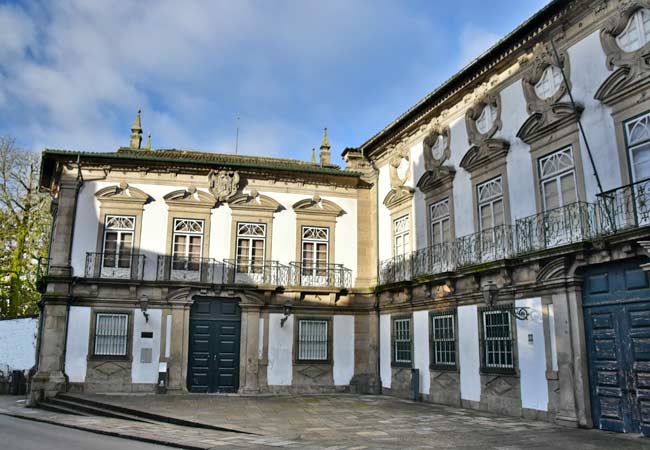
If time allows, a short detour west brings you to the Palácio dos Biscainhos, and it's one I'd recommend. The name comes not from the family who lived here but from the Basque workers (from Biscay) who were brought to Braga to build the city's fortifications. Built in the 17th century, this Baroque palace is now a museum and one of the best places in the city to understand how Braga's wealthy elite actually lived.
You get a sense of that immediately. The ground floor is paved with granite cobblestones because carriages would drive directly inside to drop off guests, keeping their silk clothes safe from the rain. Upstairs, look out for the chocolate room, dedicated entirely to the ritual of drinking hot chocolate, a colonial luxury that was more expensive than gold at the time. The Baroque gardens behind the palace are laid out across three levels and hide surprise fountains, concealed jets designed to spray unsuspecting guests as an aristocratic prank.
Rua Dr. Justino Cruz and Jardim de Santa Bárbara
From here, join Rua Dr. Justino Cruz, one of Braga's main pedestrianised shopping streets. Cafés, local boutiques, and restaurants line both sides, and this is a good spot to pause for a coffee if the morning calls for it.
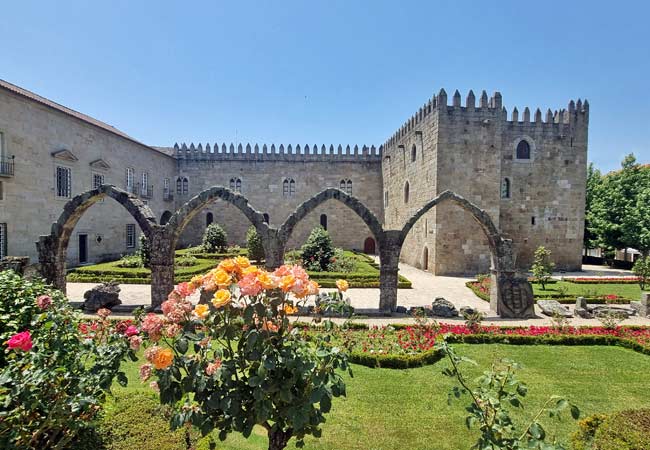
The street leads you to the Jardim de Santa Bárbara, a small formal garden that sits against the medieval Gothic walls of the Archbishop's Palace. The geometric boxwood hedges and bright flowerbeds make it one of the most photographed spots in the city, and with good reason. The contrast between the manicured garden and the weathered stone arches of the palace behind it is striking. Look for the ruined arches along the palace wall, remnants of the devastating fire of 1834.
Largo São João do Souto and Capela dos Coimbras
Continuing east you arrive at the Largo São João do Souto, home to the São João do Souto church and the distinctive Capela dos Coimbras attached to it. The chapel dates to the 16th century and is one of the oldest private chapels in the city, built by the wealthy Coimbra family so they could attend Mass without leaving home.
Its Manueline style, the uniquely Portuguese take on late Gothic architecture, gives the exterior a look that seems much older than it actually is. Inside, there is a finely carved altarpiece in Ançã stone, a limestone so soft it allows for remarkably intricate, almost lace-like detail.
Largo do Paço
From the Largo São João do Souto, retrace your steps briefly along Rua Dr. Justino Cruz to the central crossroads, then head west to the Largo do Paço. This grand square sits at the heart of the old Archiepiscopal Palace complex and has a long history as the seat of religious power in the city. In the centre stands the Chafariz dos Castelos fountain, featuring a figure holding a castle that represents the city itself.
Today the surrounding buildings form part of the University of Minho's campus, which gives the square an interesting mix of medieval architecture and student life. It's one of those spots where 14th-century walls meet 21st-century rucksacks.
Praça da República
Head back east and you'll reach the Praça da República, Braga's main square and social centre since the 14th century. The Arcada building on the north side dates from 1885, though it replaced an earlier structure built to shelter grain merchants. Beneath its arches you'll find Café Vianna, established in 1871 and one of Portugal's most storied cafés. After the First World War, the café even issued its own vouchers as makeshift currency when small change ran short.
On the square you'll also spot the Torre de Menagem, a 30-metre granite tower and the last surviving piece of Braga's medieval castle. The rest was demolished in 1906 to make way for the expanding city. At the centre sits the Nossa Senhora do Pilar fountain from 1723, originally the city's main water source and part of an 18th-century effort to give Braga the feel of a miniature Baroque Rome.
The Convento dos Congregados dominates one side of the square. Designed by André Soares, it took over 250 years to complete, with construction starting in 1703 and the exterior not finished until 1964.
Avenida da Liberdade and Theatro Circo
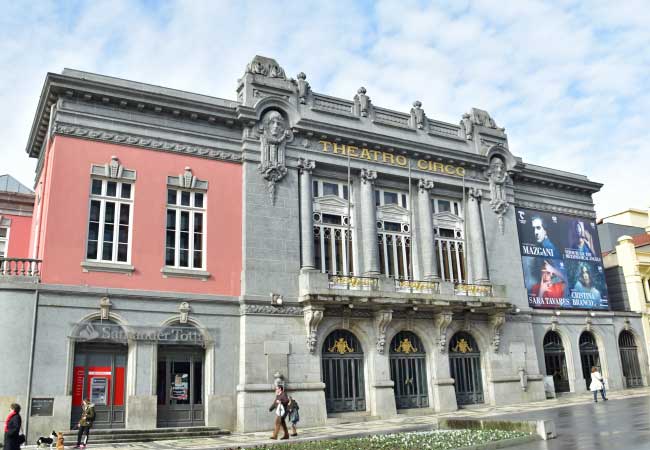
From the square, continue along Avenida da Liberdade, a grand boulevard lined with mature trees and seasonal flower beds. At the end you'll reach the Theatro Circo de Braga, a Belle Époque theatre from 1915 with an ornate painted dome and one of the largest stages in Portugal. It's still a working venue for concerts and performances, not a relic.
Largo de Santa Cruz: Palácio do Raio, São Marcos, and Santa Cruz
Turn right into the Largo de Santa Cruz, one of the city's most striking squares. Three buildings compete for your attention here.
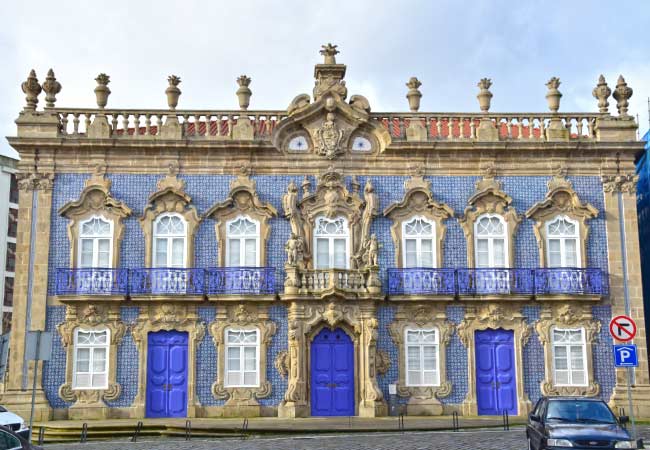
The Palácio do Raio is impossible to miss. Its vivid blue azulejo tiles make it one of the most photographed buildings in Braga, though the tiles were actually a 19th-century addition paid for by Miguel José Raio, a merchant who made his fortune in Brazil. The real story is the granite work underneath. André Soares designed the palace in 1752, using concave and convex lines on the window frames to create a sense of movement in the stone. Look closely at the pediments above the windows and you'll notice no two are exactly alike, a deliberate rejection of symmetry.
The Igreja de São Marcos was originally built to serve the neighbouring hospital. Look up at the roofline and you'll see life-sized statues of the Apostles along the top. The former hospital building next door has been converted into a hotel, so you can actually walk through corridors where patients once recovered.
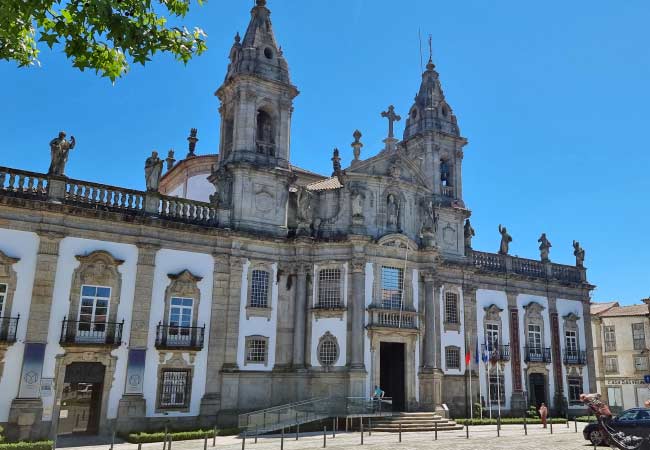
The splendid Igreja de São Marcos
The Igreja de Santa Cruz stands in contrast with its dark granite façade. The exterior is covered in carved depictions of the Instruments of the Passion, and while the outside is heavy and sombre, the interior is known for its blue and white tile panels and fine acoustics.
Capela de São Bentinho
Just off the square, a narrow cobbled alley leads to the Capela de São Bentinho, and this is one of those stops that rewards a pause. It's tiny, easily missed, and feels completely different from the grand churches you've been visiting all morning. This is where locals come, not tourists. The chapel is dedicated to St. Benedict and has a long tradition as a place of healing. You'll often see candles glowing behind the iron grate and small offerings left at the entrance egg and salt traditions before including.
If you stand here for a few minutes you'll likely see people stop briefly, touch the glass, cross themselves, and carry on with their day. It's a working place of quiet devotion that has never become a museum, and there's something genuinely moving about that.
Capela da Nossa Senhora da Torre
A short walk further brings you to the Capela da Nossa Senhora da Torre at the edge of Largo de Santiago. The chapel was built into the city's old defensive fortifications as a thank you to the Virgin Mary for protecting Braga during the catastrophic 1755 earthquake that devastated Lisbon but left Braga largely unharmed. The tower is one of the few places where you can clearly see how the medieval walls were absorbed into later religious buildings.
Climb the steps to the top for panoramic views across the historic centre. After a morning spent walking through these streets at ground level, seeing the whole city laid out below you is a satisfying way to tie the walk together.
Lunch
From here, turn right onto Rua Dom Afonso Henriques to loop back to the Largo de São João do Souto. The surrounding pedestrianised streets are full of restaurants, and this is the best spot in the city for lunch. Take your time here before heading to Bom Jesus for the afternoon.
Bom Jesus do Monte
After lunch, make your way to Avenida da Liberdade for the bus to Bom Jesus, or grab an Uber or Bolt for the ten-minute drive. The bus drops you at the base of the complex, right by the funicular station.
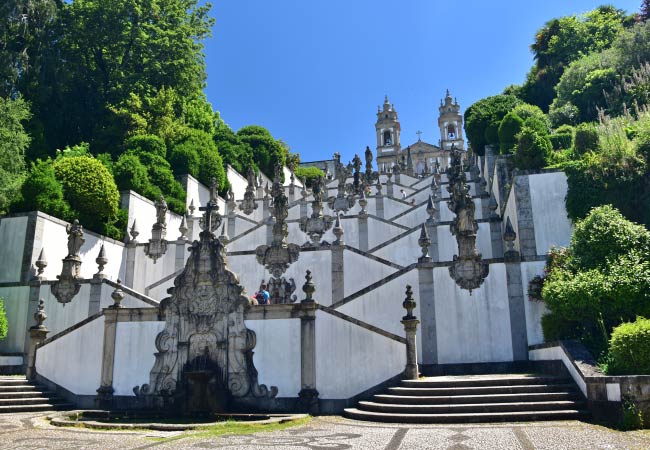
The Baroque stairway of Bom Jesus climbs 116 metres up a wooded hillside through 577 steps, built between 1722 and 1811. The entire site was designed as a Sacred Mountain, allowing pilgrims who could never travel to Jerusalem to experience the Passion of Christ closer to home.
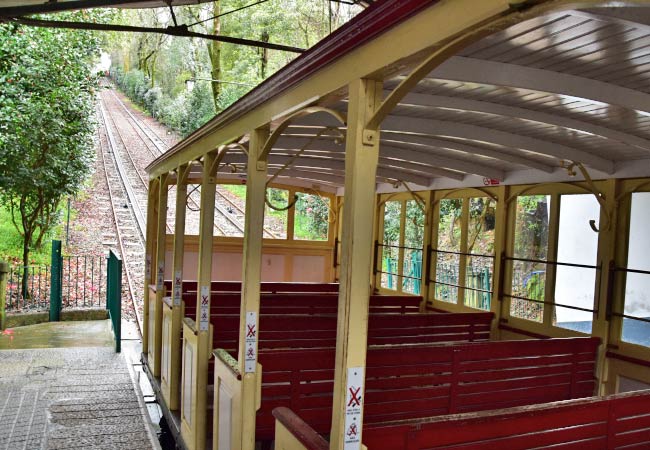
You have two options for reaching the summit. The Elevador do Bom Jesus do Monte is the world's oldest funicular still running on its original water-counterbalance system, built in 1882. The mechanics are beautifully simple: the upper car's tank is filled with around 3,000 litres of spring water, and that extra weight pulls the lower car up the 274-metre track. When it reaches the base, the water drains out with a loud hiss. The three-minute ride takes you up in polished brass and varnished wood interiors restored to their original 1882 appearance.
Alternatively, you can climb the stairway itself, which is split into three distinct sections. The lowest and longest, the Portico Staircase, winds through shaded woodland past small chapels containing life-sized terracotta scenes of Christ's Passion. From here the character changes completely. The Stairway of the Five Senses is the famous Baroque zigzag, where fountains pour water from the eyes, nose, ears, and mouth of carved figures, representing the purification of the pilgrim's senses. The final section, the Stairway of the Three Virtues (Faith, Hope, and Charity), leads to the church courtyard. There's a clever architectural trick at work throughout: the steps narrow as they rise, creating a forced perspective that makes the church appear larger from below.
Many visitors ride the funicular up and walk down, which lets you experience both the engineering of the funicular and the full stairway at a leisurely, downhill pace. If you do walk up, be warned that it is a genuinely demanding climb, especially in summer heat.
At the summit, the church houses an 18th-century organ and an altar crafted from Brazilian jasper. The surrounding park of old cedar and oak trees offers a cool escape, with grottoes, viewpoints, and a small rowing lake tucked among the woods. The views from the top stretch across the Minho valley and on a clear day reach considerably further.
When you're ready, descend by funicular and catch the bus back to the city centre. From there the railway station is a short walk west, and you'll have seen the very best of Braga in a single, well-paced day.
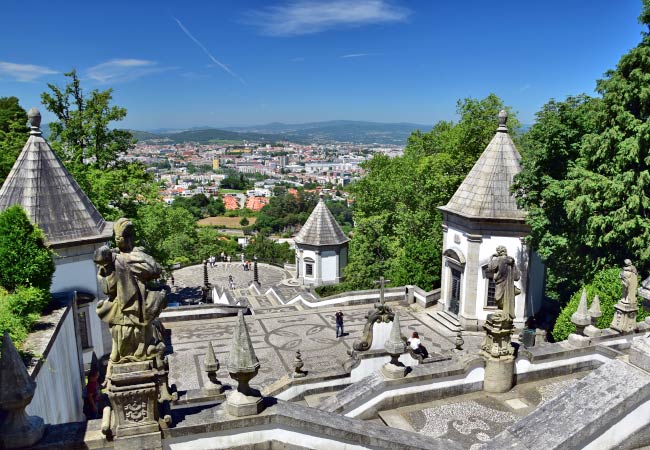
The Miradouro do Santuário do Bom Jesus
Our most popular guides to Braga and North Portugal


Expert Insight: I'm Philip Giddings. I've been visiting Portugal since 2001 and now live here, in the Graça district of Lisbon, with my Portuguese wife Carla, whose family go back generations. Carla first brought me to Braga and Northern Portugal on an early trip, proud to show me her country, and 25 years on we still travel here almost every month to see her aunt and extended family, who live within the region.
I've been writing the independent guides at Porto-North-Portugal.com since 2010, and the site is now my full-time work. Living in Portugal, married into a Portuguese family, and visiting Northern Portugal every month gives me a first-hand insight that many foreign blog writers simply don't have.
The site now has 174 guides on Braga and Northern Portugal. It takes no payment from tourist boards, tour operators, or attractions for inclusion, and is funded by affiliate commissions on tour bookings, which are disclosed on every page that contains them. Every practical detail (ticket prices, opening hours, bus routes, time-slot policies) is checked against official sources and verified in person on the walks I make through the city. Read my full story here.