Porto-North-Portugal.com
The best independent guide to north Portugal
Porto-North-Portugal.com
The best independent guide to north Portugal
Trancoso, Portugal: an independent travel guide for 2026
In 1282, a king married his twelve-year-old queen behind these walls, then handed her the town as a wedding present. Seven hundred and forty years later, the chapel where Dinis and Isabel of Aragon exchanged their vows still stands, the cobbles outside it have hardly shifted, and the walls he later thickened in her honour still circle the old town. I've walked a lot of Portuguese towns, and few wear their history as openly as this one.
The town sits high on a granite plateau at 870 metres, and from the top of the castle keep you can see all the way to the Spanish border. That's why it mattered: a frontier stronghold fought over first by Moors and Christians, then by Portuguese and Castilians. Inside the walls, you'll find a tight grid of cobbled lanes, granite houses, and the handsome Praça Dom Dinis at the centre. You could cross the historic centre in ten minutes, but I'd urge you not to. Trancoso gives up its details slowly, and the pleasure is in the noticing.
What gives Trancoso its particular character, though, is its Jewish heritage. By the 15th century, around 700 Jews lived here, enough that the king himself granted permission to enlarge the synagogue, and the legacy is everywhere once you know where to look. Hebrew inscriptions on lintels. Stars of David carved into doorways. The distinctive twin entrances of merchant houses, a wide door for the shop and a narrow one beside it for the family. Other doorways still carry small crosses scratched into them by the Inquisition to mark forced conversions, a quiet detail you would walk straight past if no one pointed it out.
Beyond the walls, Trancoso opens onto one of the most underexplored corners of Portugal. The star-shaped fortress of Almeida, the cinematic castle ruins of Marialva and Castelo Rodrigo, the foothills of the Serra da Estrela, and the Palaeolithic rock art of the Côa Valley are all within an hour's drive. On most of our visits we've had them very nearly to ourselves. You'll need a car out here. The roads are quiet, the villages are largely untouched by tourism, and the sense of having stumbled onto something half-forgotten is a large part of the pleasure.
I've been travelling in Portugal since 2001, and together with my Portuguese wife I've come back to Trancoso more times than I can count. Sometimes for a half-day on the way to Spain, more often as a base for working our way slowly through the Beira region. This guide passes on what we have learned, so you can decide whether to come for a quick stop at the castle or settle in for the longer, slower stay we think the town and the country around it deserve.
Related article: The Beira region
Highlights of Trancoso
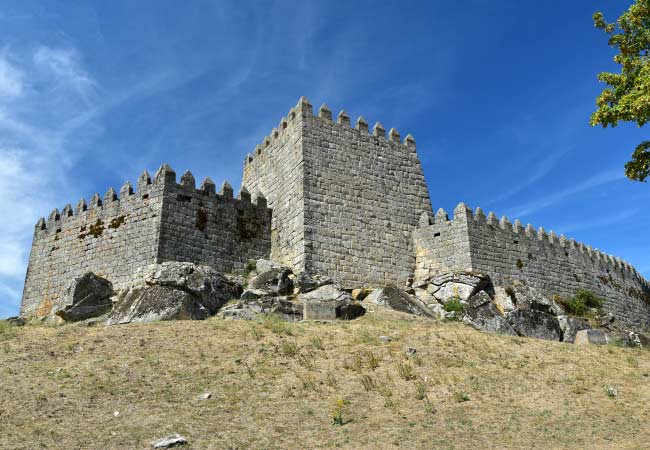
The Castle of Trancoso
A thousand-year-old fortress crowning the town, with five rectangular towers and a Moorish-influenced keep at its centre. Climb the steps to the top and the entire frontier opens up beneath you, the cobbled streets directly below and the high plateau rolling east, all the way to Spain.
The Porta d'El Rei
The grandest of the medieval gates and the most theatrical way into the old town. Two crenellated towers flank a heavy stone arch, and above it the carved coat of arms of King Dinis still sits where his masons placed it in 1282.
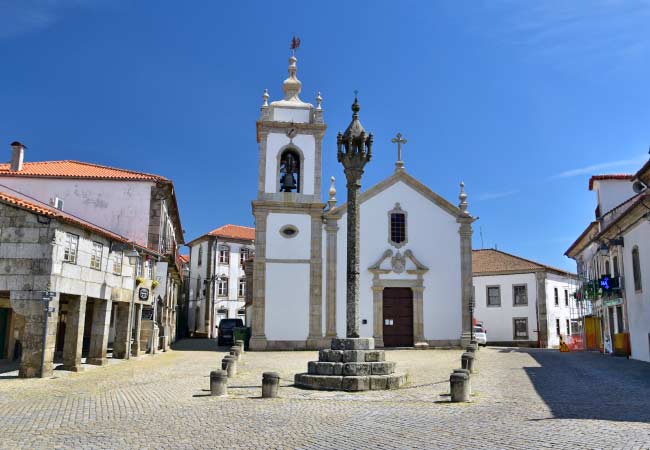
The Praça Dom Dinis
The main square of Trancoso, and the place where most of the town's history is layered into a single open space. The Manueline pillory of 1510 stands at its centre, and the late-Baroque Igreja de São Pedro, with the tomb of the prophet Bandarra inside, rises along one side.
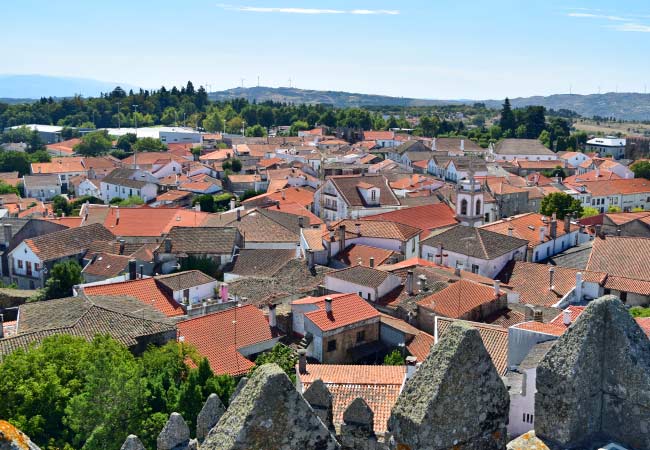
The old Jewish quarter
A warren of narrow lanes still carved with the traces of what was once one of Portugal's largest Jewish communities. Twin doorways on the merchant houses, Hebrew inscriptions on the lintels, and Stars of David cut into the granite above the windows.
A day trip to Trancoso
If you are touring the Beira region, a half day in Trancoso is the right amount of time. The historic centre is compact, contained entirely within the medieval walls, and the headline sights are all within a ten-minute walk of one another. You could rush it in an hour, but two to three is closer to honest, and a long lunch at one of the tascas inside the walls turns it into a relaxed half day without much effort.
A day trip to Trancoso is most often paired with a visit to the ruined castle of Marialva, twenty kilometres to the north. The two are very different in character. Trancoso is a living town, busy and lived-in, while Marialva is a near-abandoned medieval village inside its old walls, slowly being reclaimed by nature. Together they make one of the most satisfying day-trip pairings in the region. Trancoso is the larger of the two and the better lunch stop, so the standard pattern is Trancoso in the morning, lunch here, then on to Marialva for the afternoon.
There is a large free car park to the south of the historic quarter, clearly signposted as you approach the town. From there it is a two-minute walk to the Porta d'El Rei and into the old town. Do not try to drive inside the walls. The streets were laid out for medieval feet, and the gates were narrowed deliberately to stop a cavalry charge.
The map below shows a suggested walking tour of Trancoso, beginning and ending at the main car park. Zoom out on the map to see the other historic towns of the wider region.
Sights of the tour: 1) Porta d'El Rei 2) Câmara Municipal 3) Praça Dom Dinis 4) Igreja de São Pedro 5) Rua da Alegria 6) Castle of Trancoso 7) Igreja de Santa Maria 8) Portas do Prado
The route takes you in through the Porta d'El Rei, up through the heart of the old town to the Praça Dom Dinis (3), the main square of Trancoso, with the Manueline pillory at its centre and the Igreja de São Pedro alongside. From the square, the Rua da Alegria (5) is the cobbled lane that climbs gently up to the castle, and from the top of the castle keep you have one of the finest views in the Beira region. Coming back down, the western gate at the Portas do Prado (8) has steps onto the ramparts where you can walk a stretch of the wall back towards the car park.
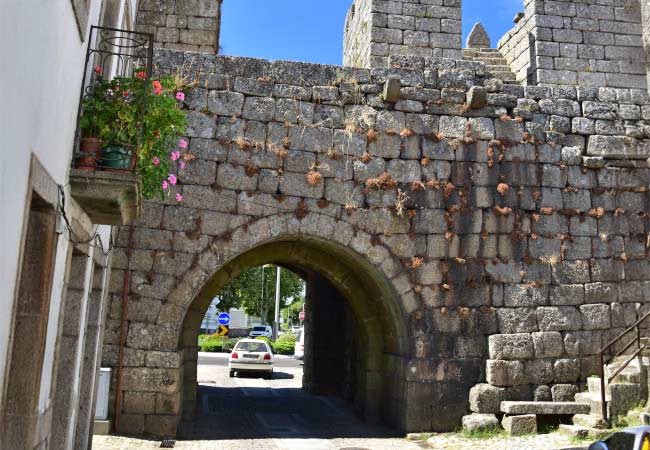
The Portas do Prado gateway, with steps on the right to the top of the walls
Where to eat
There are a handful of traditional tascas and restaurants within the walls and just outside them, mostly clustered around the Praça Dom Dinis and the streets running off it. The local specialities are roast kid (cabrito) and lamb, hearty winter dishes built for the cold of the high plateau, plus the regional sweet, sardinhas doces de Trancoso, made of marzipan rather than fish despite the name.
A few places worth knowing:
• Restaurante Dom Gabriel. Inside the old town, set in a restored stone building near the Praça Dom Dinis. Traditional Beira cooking, generous portions, fair prices.
• Restaurante São Marcos. In a restored manor house with views across to the castle, slightly more formal than the tascas inside the walls, with a strong regional menu.
• Restaurante O Museu. Housed in the 15th-century granite home of Padre Costa, the priest who, according to local legend, fathered 299 children and was pardoned by King João II. The royal pardon still hangs in the dining room. Hearty regional cooking served in clay pots, and the signature dish is the celebrated Vitela à Padre Costa, slow-cooked veal that lives up to the local hype.
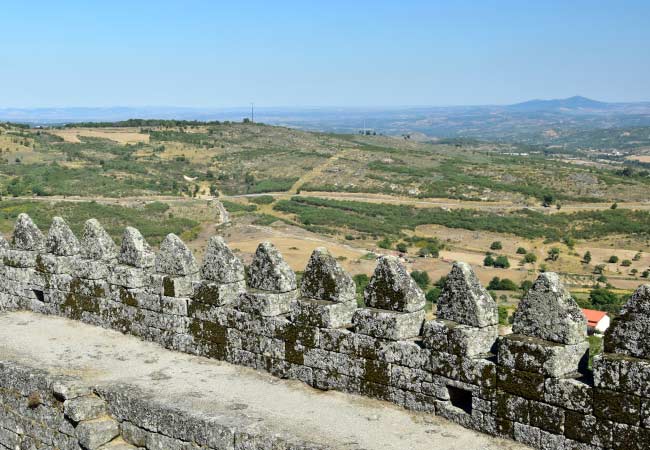
From the top of the keep in the castle, you can see all the way to the Spanish border
Why use Trancoso as a base for the Beira region
Most travellers come to Trancoso for half a day, then move on. I would push you to think differently. The town sits at the centre of one of the most underexplored corners of inland Portugal, an old frontier landscape strung with castles, fortified villages, and granite hill towns that almost no one visits. Stay a week here and you will see more of medieval Portugal than you would in a fortnight on the coast.
The geography helps. Trancoso has unusually good road connections for somewhere this remote, sitting at the crossroads of the fast IP2 running north to south and the A25 expressway just below town. Almost everywhere worth seeing in the region is within forty-five minutes' drive, often less.
To the east lies Almeida, the most extraordinary star-shaped fortress in Portugal. To the north, the haunting ruined castles of Marialva and Castelo Rodrigo, both perched on isolated hilltops with views deep into Spain. To the south, the granite hill villages of Linhares and Folgosinho, gateway to the high Serra da Estrela. Further north still, the Côa Valley with the oldest open-air Palaeolithic rock art in the world, and the upper reaches of the Douro at Pocinho. To the west, the regional capital of Viseu, a proper working city with one of the finest small museums in the country.
For a full week based in Trancoso, this is the order I would suggest. It groups the sights geographically, keeps the longest drives for days when you have the energy for them, and saves the regional capital for the end when you are ready for a city again.
• Day 1: Trancoso itself, with Marialva in the afternoon
• Day 2: Almeida, Castelo Rodrigo, and Pinhel
• Day 3: Linhares, Folgosinho, and the N339 across the Serra da Estrela
• Day 4: Monsanto, a long but memorable day on the road
• Day 5: Vila Nova de Foz Côa and the upper Douro at Pocinho
• Day 6: Viseu
Trancoso also works well as a base in its own right. The town is busier and more lively than its size suggests, with a good handful of restaurants, traditional cafés, and small shops within the walls, enough to keep an evening interesting after a long day on the road. You will find everything you need without ever having to drive somewhere else for dinner, which is more than can be said for many of the smaller villages nearby.
The map below shows the best hotels and rental rooms within the town and a short walk of the historic centre. Adjust the dates to your stay and it will display current prices and availability.
The Castle of Trancoso
The castle has been here, in some form, for more than a thousand years. The first written mention dates to 960, but the hilltop was almost certainly fortified long before that, first by Romans, then by Visigoths, then by the Moors who held it until 1160. What you see today is the work of half a dozen rulers stacked one on top of the other, each adding a wall, a tower, or a gate as the frontier shifted around them. The result is one of the most evocative castles in this part of Portugal, and the single best reason to climb the hill at the north-eastern edge of the old town.
Look up at the keep before you go in. Its walls lean inward at the base, a distinctive slope you do not see on later Christian fortresses. This is Moorish work, the bones of the original tower the Christians inherited and never quite replaced. The Knights Templar took the castle in 1173, converted that older Mozarabic tower into a defensive keep, and threw a curtain wall around it. A century later, King Dinis arrived, the same Dinis who married Isabel of Aragon in the chapel below, and ordered the great expansion of 1282 that gave the castle and the town walls the shape they still hold today.
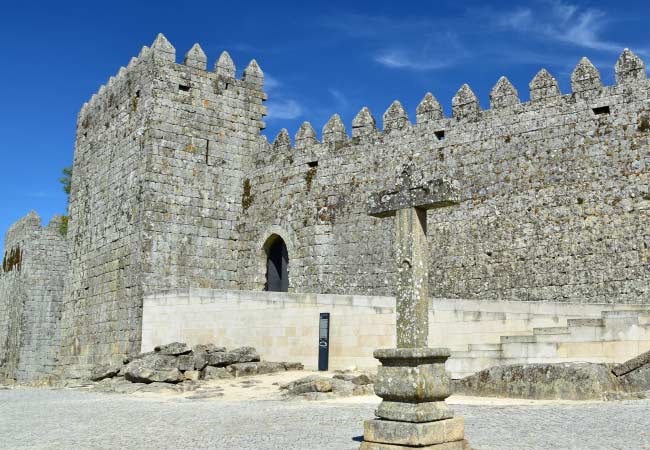
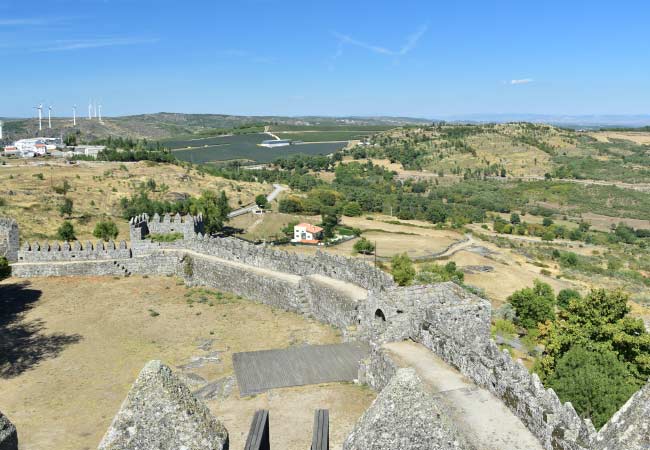
You enter the castle grounds through a modern bridge of local granite, part of a careful 2006 restoration. The grounds inside are open and largely empty, with the ruined remains of a 16th-century chapel of Santa Bárbara to one side, an old well, and a cistern. Five rectangular towers punctuate the curtain walls. None of them are interpreted with displays or signage, which I rather like.
The reason most people come, however, is the climb to the top of the keep. A flight of stairs takes you up through the tower, and the platform at the summit gives you what is, in my opinion, one of the finest views in the Beira region. To the north and east, the high plateau rolls away in long, gentle ridges all the way to the Spanish border, perhaps thirty kilometres distant on a clear day. To the south, the granite shoulders of the Serra da Estrela rise into view. Directly below, the cobbled grid of the old town is laid out like a map, with the church towers of São Pedro and Santa Maria pinning down the corners. It is this view that explains why anyone would have built a castle here in the first place.
A walking tour of Trancoso
The walk I would suggest begins and ends at the main car park to the south of the historic quarter, just outside the walls. Do not try to drive into the old town. The streets were laid out for medieval feet and donkey carts, and the gates were narrowed deliberately to stop a cavalry charge, never mind a hire car with a nervous driver at the wheel.
From the car park, walk up to the Porta d'El Rei, the grandest of the medieval gates, with the coat of arms of Dinis carved into the stone above the arch. This was the king's own entrance into the town, and seven and a half centuries on, it is still the most theatrical way in. Once through the gate, follow the cobbles up towards the heart of the old town.
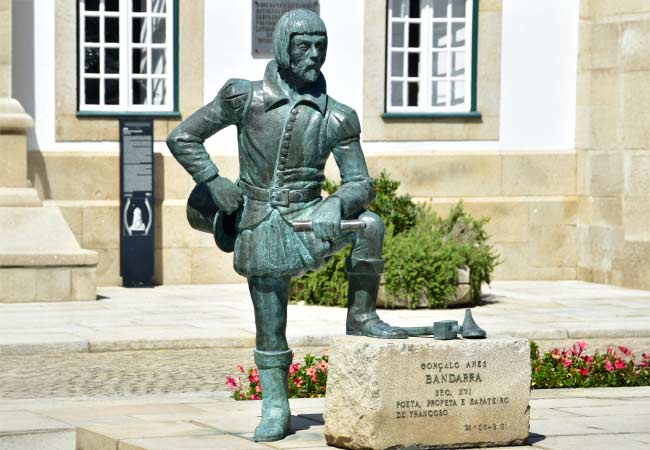
You will arrive at the Praça Dom Dinis, the main square of Trancoso. Three things to look at here. The Pelourinho, a slender Manueline pillory in the centre of the square, dating from 1510 and once used to display the condemned. The Igreja de São Pedro alongside it, an unfussy late-Baroque church from the 1720s that holds the tomb of Bandarra, the 16th-century shoemaker-prophet whose verses foretold the return of King Sebastião and made him both famous and a target of the Inquisition. The bronze statue of Bandarra stands on the Praça do Município, hammer in hand, looking like the village cobbler he in fact was.
From the square, take the Rua da Alegria, a narrow cobbled lane lined with traditional granite houses that climbs gently up to the castle. The name means "street of joy" and on a sunny morning, with the bougainvillea spilling over the doorways, you will see why. It leads you to the Castle of Trancoso, which I would set aside at least an hour for. The keep, the views from the top, and the layered history of the place are all covered in detail in the dedicated castle section above.
Coming back down from the castle, take a slightly different route through the old Jewish quarter, the warren of streets to the west of the Praça Dom Dinis. This is where the careful eye repays itself. Look for the twin doorways of the merchant houses, the Hebrew inscriptions on the lintels, and the small crosses scratched in by the Inquisition. The Casa do Gato Negro is the most striking single building, thought to have been the rabbi's home. The Centro de Interpretação da Cultura Judaica Isaac Cardoso, a small but excellent museum nearby, is well worth thirty minutes if you want the context.
Finish at the Portas do Prado, the gate at the western end of the walls. There are stone steps to the right of the gate that take you up onto the ramparts, and you can walk a stretch of the wall back towards the car park from here. Mind your footing. There are no handrails, the steps are very worn, and the drop is real. The view across the rooftops is worth the small effort. From the wall, drop back down through the gate and follow the path around the outside of the walls to where you started.
Our most popular guides to Northern Portugal


Expert Insight: I'm Philip Giddings. I've been visiting Portugal since 2001 and now live here, in the Graça district of Lisbon, with my Portuguese wife Carla, whose family go back generations. Carla first brought me to Northern Portugal on an early trip, proud to show me her country, and 25 years on we still travel north almost every month to see her aunt and extended family, who live within the region.
I've been writing the independent guides at Porto-North-Portugal.com since 2010, and the site is now my full-time work. Living in Portugal, married into a Portuguese family, and visiting Northern Portugal every month gives me a first-hand insight that many foreign blog writers simply don't have.
The site now has 174 guides on north Portugal. It takes no payment from tourist boards, tour operators, or attractions for inclusion, and is funded by affiliate commissions on tour bookings, which are disclosed on every page that contains them. Every practical detail (ticket prices, opening hours, bus routes, time-slot policies) is checked against official sources and verified in person on the walks I make through the city. Read my full story here.